> For the complete documentation index, see [llms.txt](https://docs.maiagent.ai/llms.txt). Markdown versions of documentation pages are available by appending `.md` to page URLs; this page is available as [Markdown](https://docs.maiagent.ai/org/overview.md).

# 組織與成員管理

組織、角色、成員三層結構，以及角色裡裝的三樣東西：功能權限、建立權限、資源綁定。第一次設定組織前先讀這頁。

## 什麼是組織與成員管理？ <a href="#what-is-organization-member-management" id="what-is-organization-member-management"></a>

MaiAgent 的組織與成員管理，就像替公司開一間「數位辦公室」：先把公司建成一個組織，在裡面設部門（角色），決定每個部門能用什麼，再把同仁加進對應的部門。

這套設計基於 **RBAC**（Role-Based Access Control，角色權限控制）：權限設在角色上，不設在人身上。

{% hint style="info" %}
**簡單理解：**

RBAC 是「先設定職位，再把人加進職位」。你先定義「客服專員」能做哪些事，再把張先生、李小姐加進這個角色，他們就自動擁有客服專員的所有權限，不用逐一設定。
{% endhint %}

***

## 三層結構：組織 → 角色 → 成員 <a href="#three-tier-structure" id="three-tier-structure"></a>

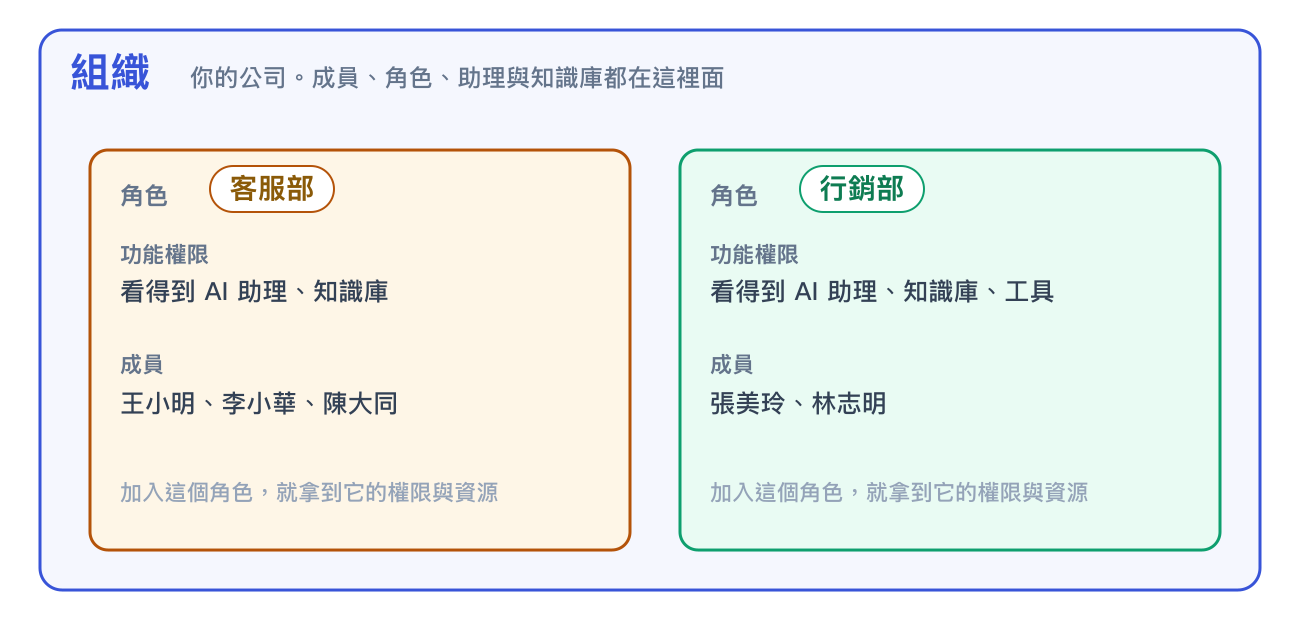
<figure><img src="https://1593648278-files.gitbook.io/~/files/v0/b/gitbook-x-prod.appspot.com/o/spaces%2Fmzb5NG9GDzFP2YDKeYVl%2Fuploads%2Fgit-blob-1e68b73f3dd87c7d0aacaaa5f90d0f5444f7912f%2Forg-structure.png?alt=media" alt="組織、角色、成員的三層結構"><figcaption><p>一個組織裡有多個角色，成員加入角色就拿到那個角色的權限與資源</p></figcaption></figure>

<table><thead><tr><th width="140">層級</th><th width="220">對應到公司</th><th>說明</th></tr></thead><tbody><tr><td><strong>組織</strong></td><td>你的公司</td><td>最上層的管理單位。成員、角色、Agent、知識庫都屬於某一個組織，組織之間完全隔離。</td></tr><tr><td><strong>角色</strong></td><td>部門或職位</td><td>權限與資源的容器。一個成員可以同時隸屬多個角色，權限取聯集。</td></tr><tr><td><strong>成員</strong></td><td>員工</td><td>組織裡的使用者。自己沒有權限，全部從所隸屬的角色來。</td></tr></tbody></table>

***

## 一個角色裡裝什麼 <a href="#what-a-role-holds" id="what-a-role-holds"></a>

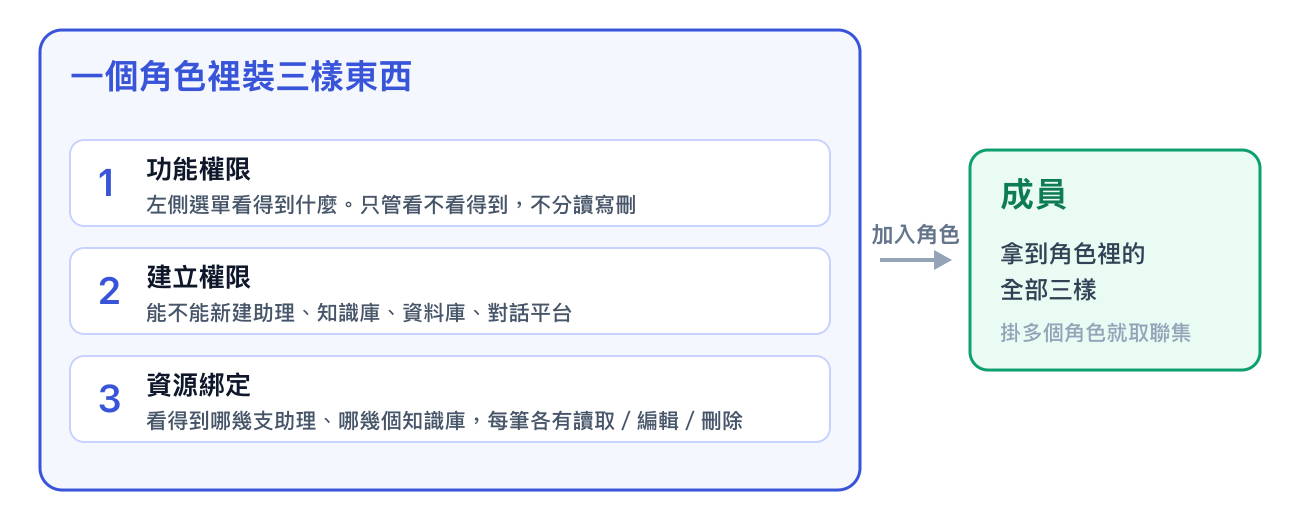
很多人用「新增／讀取／修改／刪除」的框架來想權限，但平台不是這樣切的。一個角色裡有三樣東西，三者是「而且」的關係：

<figure><img src="https://1593648278-files.gitbook.io/~/files/v0/b/gitbook-x-prod.appspot.com/o/spaces%2Fmzb5NG9GDzFP2YDKeYVl%2Fuploads%2Fgit-blob-5b0f9f797f33ee2191be97491b9767429d8e5dd6%2Forg-role-contents.png?alt=media" alt="角色裡的三樣東西：功能權限、建立權限、資源綁定"><figcaption><p>要讓成員能建 Agent，功能權限的「AI 助理」與建立權限的「允許新增 AI 助理」都要開</p></figcaption></figure>

<table><thead><tr><th width="150">層</th><th width="250">決定什麼</th><th>在哪裡設定</th></tr></thead><tbody><tr><td><strong>功能權限</strong></td><td>左側選單看得到什麼。只管看不看得到，不分讀寫刪</td><td>角色的<mark style="color:blue;">角色權限</mark>分頁。父權限勾了會自動包含底下所有子權限，也可以只勾部分子權限</td></tr><tr><td><strong>建立權限</strong></td><td>能不能新建 Agent、知識庫、資料庫、對話平台</td><td>各資源分配分頁最上方的「允許新增」勾選</td></tr><tr><td><strong>資源綁定</strong></td><td>看得到哪幾個 Agent、哪幾個知識庫；每一筆各有讀取、編輯、刪除三個開關</td><td>角色的<mark style="color:blue;">分配 AI 助理</mark>、<mark style="color:blue;">分配知識庫</mark>等分頁</td></tr></tbody></table>

{% hint style="info" %}
**簡單理解：**

功能權限是「看得到哪些房間」，建立權限是「能不能在房間裡蓋新東西」，資源綁定是「房間裡哪幾樣東西你拿得到、改得動」。三把鑰匙都在角色上，人加入角色才拿到。
{% endhint %}

### 可以分配給角色的資源 <a href="#assignable-resources" id="assignable-resources"></a>

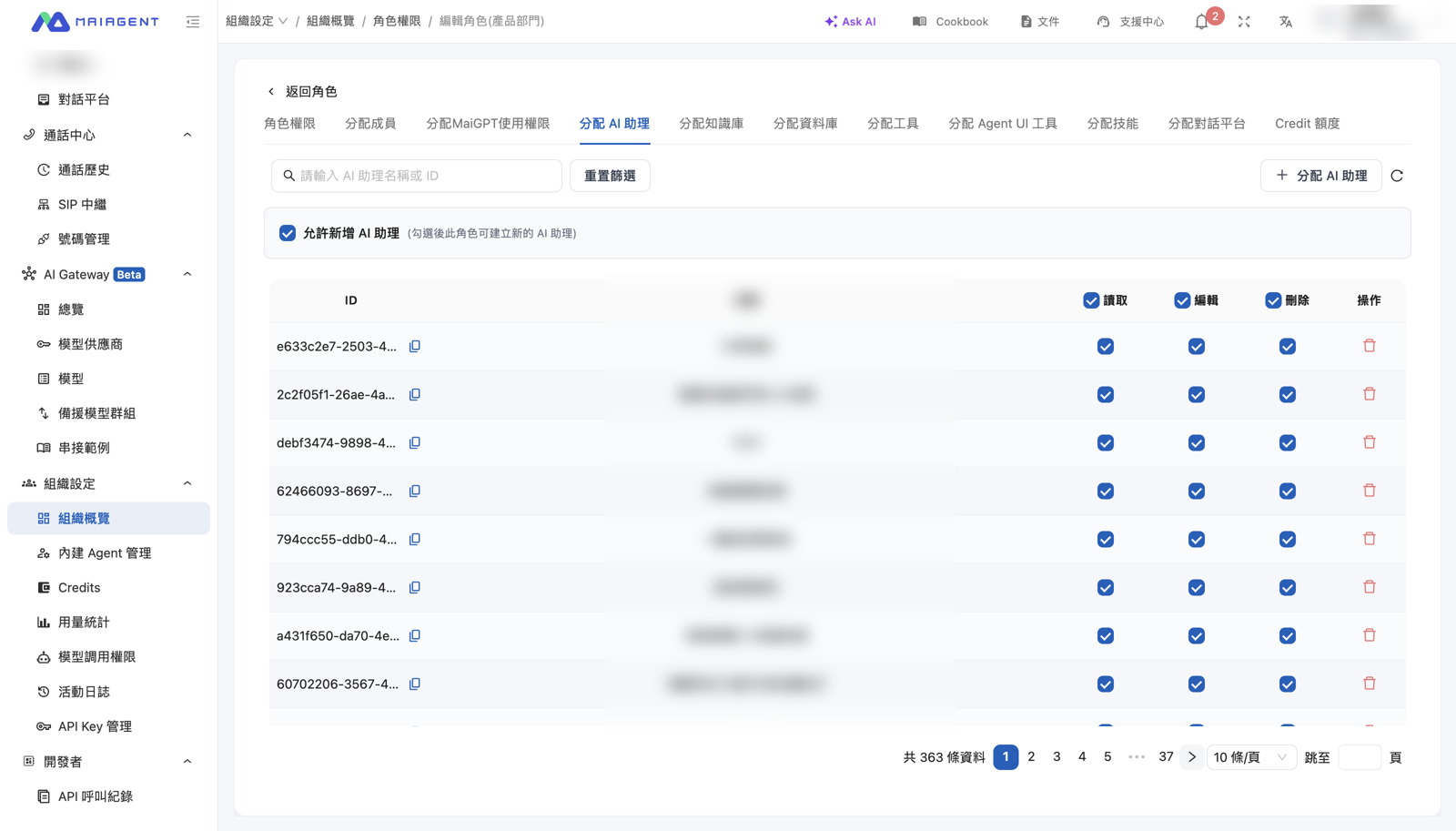
角色編輯頁的分頁列就是可分配的資源：

* **AI 助理**、**知識庫**、**資料庫**、**對話平台**：各帶讀取／編輯／刪除
* **工具**、**技能**、**Agent UI 工具**：指定角色可掛在 Agent 上的能力元件
* **MaiGPT 使用權限**：這個角色能不能用 MaiGPT
* **Credit 額度**：這個角色的用量上限，詳見 [Credits 計費制度](/others/credits.md)

<figure><img src="https://1593648278-files.gitbook.io/~/files/v0/b/gitbook-x-prod.appspot.com/o/spaces%2Fmzb5NG9GDzFP2YDKeYVl%2Fuploads%2Fgit-blob-35a58fc73f8a7799cbbf9f69149587f18c42bdc1%2Frole-design-assign-chatbots.png?alt=media" alt="角色編輯頁的分配 AI 助理分頁"><figcaption><p>角色編輯頁：上方分頁列是可分配的資源，「允許新增」是建立權限，每列的讀取／編輯／刪除是資源綁定</p></figcaption></figure>

***

## 核心概念 <a href="#core-concepts" id="core-concepts"></a>

### 角色有三種 <a href="#role-types" id="role-types"></a>

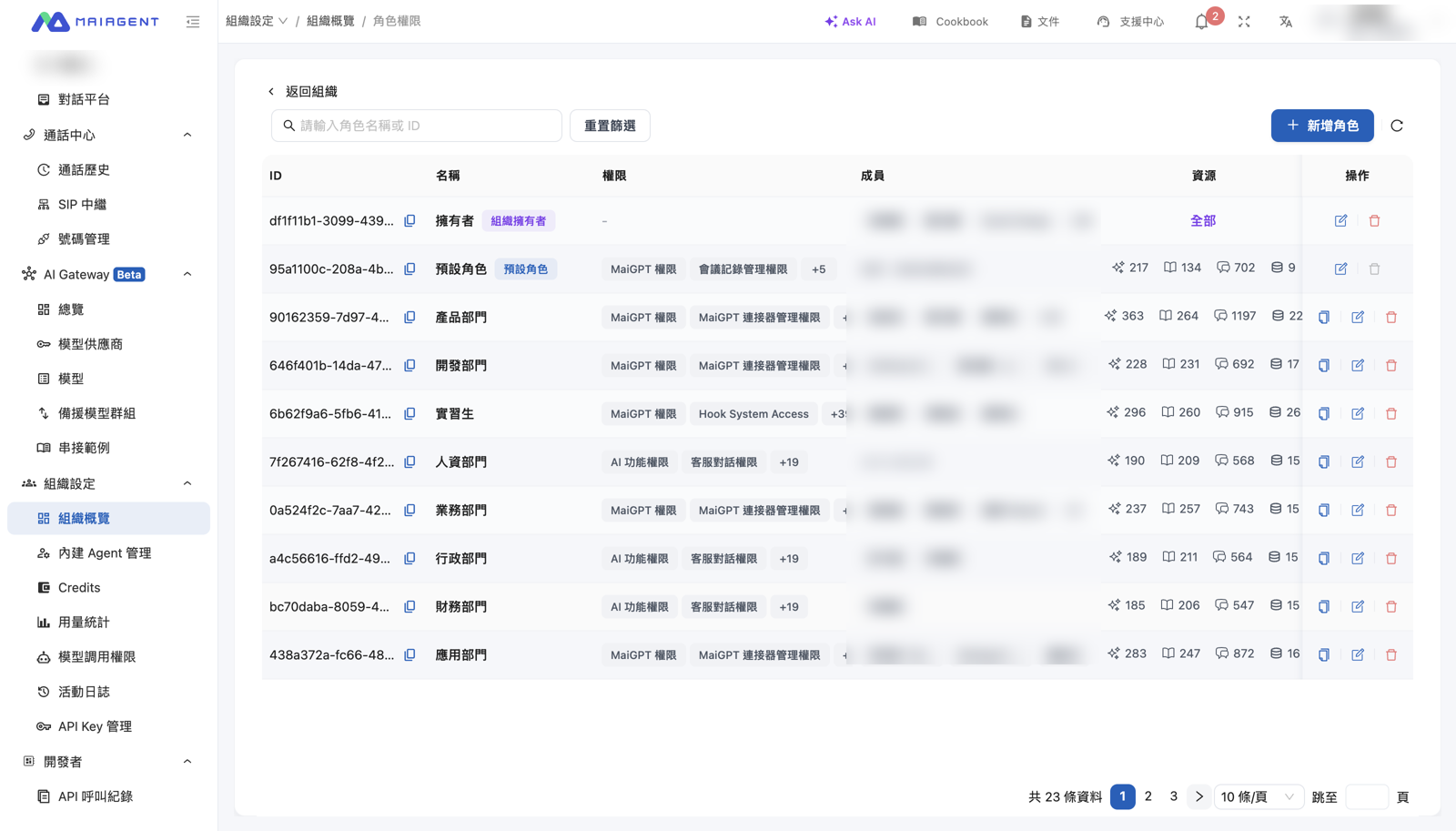
<table><thead><tr><th width="150">類型</th><th width="250">誰在裡面</th><th>特性</th></tr></thead><tbody><tr><td><strong>擁有者</strong></td><td>組織建立者，或被指派的管理員</td><td>略過所有權限檢查，組織內全部資源都看得到、改得動。可以有多位</td></tr><tr><td><strong>預設角色</strong></td><td>全體成員，自動隸屬</td><td>它給什麼權限，全公司就有什麼；它綁了哪個 Agent，全公司就都看得到。建議只留最低權限、不綁任何資源</td></tr><tr><td><strong>自訂角色</strong></td><td>被指派的成員</td><td>依部門或職位建立，可複製，可批次指派</td></tr></tbody></table>

<figure><img src="https://1593648278-files.gitbook.io/~/files/v0/b/gitbook-x-prod.appspot.com/o/spaces%2Fmzb5NG9GDzFP2YDKeYVl%2Fuploads%2Fgit-blob-3d1c9633678d3a9d5a13981ad57674eb4e02d3b4%2Forg-roles-list.png?alt=media" alt="角色權限管理列表"><figcaption><p>角色列表：擁有者、預設角色與自訂角色，各自顯示權限、成員與綁定的資源數</p></figcaption></figure>

### 成員有兩種 <a href="#member-types" id="member-types"></a>

<table><thead><tr><th width="150">類型</th><th>權限範圍</th></tr></thead><tbody><tr><td><strong>擁有者</strong></td><td>全部。可以管理組織設定、角色與成員</td></tr><tr><td><strong>一般成員</strong></td><td>預設角色的權限，加上所有被指派角色的權限</td></tr></tbody></table>

{% hint style="warning" %}
**可見性只看角色，不看建立者。** 一個 Agent 綁到哪些角色，那些角色的成員就看得到；平台不會因為「這是我建的」就多給權限。要讓 Agent 只有建立者自己看得到，唯一的方法是一人一個角色，做法見 [角色權限規劃指南](/org/roles/role-design-guide.md)。
{% endhint %}

***

## 建議的設定順序 <a href="#setup-guide" id="setup-guide"></a>

{% hint style="success" %}

1. **建立組織**：[組織管理](/org/overview/organization.md)
2. **接上登入方式**：要用公司帳號登入就先設 [第三方登入（SSO）](/org/sso.md)，成員信箱要與 SSO 一致
3. **收斂預設角色**：只留最低權限，不綁任何資源
4. **建立角色**：依部門或職位建立，勾功能權限與建立權限，見 [角色權限管理](/org/roles/role-permission.md)
5. **分配資源**：把 Agent、知識庫等綁到角色，設好讀取／編輯／刪除，見 [角色資源存取權限](/org/roles/group-resource-access.md)
6. **加入成員並指派角色**：[成員管理](/org/overview/member.md)，人多用批次匯入
7. **用一般成員的帳號實測**：擁有者略過所有檢查，測不出真實畫面
   {% endhint %}

***

## 相關頁面 <a href="#related-pages" id="related-pages"></a>

* [組織管理](/org/overview/organization.md)：建立、切換、管理組織
* [角色與權限](/org/roles.md)：角色權限管理、資源存取權限、成員篩選、角色與聯絡人的差異、角色權限規劃指南
* [成員管理](/org/overview/member.md)：新增、刪除成員，指派角色
* [第三方登入（SSO）](/org/sso.md)、[身分同步（LDAP／SCIM）](/org/identity-sync.md)：用公司帳號登入與同步成員
* [公告管理](/org/overview/announcements.md)：發布組織公告給全部成員或指定角色、成員


---

# Agent Instructions
This documentation is published with GitBook. GitBook is the documentation platform designed so that both humans and AI agents can read, navigate, and reason over technical content effectively. Learn more at gitbook.com.

## Querying This Documentation
If you need additional information that is not directly available in this page, you can query the documentation by asking a question.

Perform an HTTP GET request on the following URL with the `ask` and `goal` query parameters:

```
GET https://docs.maiagent.ai/org/overview.md?ask=<question>&goal=<user_goal>
```

`ask` is the immediate question: it should be specific, self-contained, and written in natural language.
`goal` is what the user is ultimately trying to achieve, the reason they need the answer. Sharing it helps GitBook give you a better, more relevant answer. A goal is most helpful when it describes the outcome the user wants rather than restating the question. For example, with `ask=how do I create an API token`, a goal like `automate deployments from our CI pipeline` lets GitBook tailor the answer to that use case.

The response will contain a direct answer to the question and relevant excerpts and sources from the documentation.

Use this mechanism when the answer is not explicitly present in the current page, you need clarification or additional context, or you want to retrieve related documentation sections.