> For the complete documentation index, see [llms.txt](https://docs.maiagent.ai/llms.txt). Markdown versions of documentation pages are available by appending `.md` to page URLs; this page is available as [Markdown](https://docs.maiagent.ai/maiagent-user-guide/en/tools/tool-display-settings.md).
# Customize Tool Message Display
Customize the copy, level of detail, and result format shown in conversations when API, MCP, and Function tools run.
When an AI assistant calls a tool, you can control how much execution information appears in the conversation and format the tool results for easier reading. These settings apply to API, MCP, and Function tools.
{% hint style="info" %}
Members with permission to edit the tool can modify the display copy, display mode, and output rendering template. Members without edit permission can only view these settings.
{% endhint %}
## Use Case
A customer service manager creates an API tool for looking up trial requests. She wants customer service agents to see the lookup progress without expanding all the technical details. On the tool's **Display Copy** tab, she selects **Compact** and configures the text displayed when execution finishes. When the assistant later calls the tool, customer service agents see a brief execution status instead of the tool's complete input and output.
## Configure the Display
{% stepper %}
{% step %}
### Open the Tool Editor
From the left menu, go to AI Features → Tools. Find the tool you want to configure in the tool list, then click the edit icon on the right.
{% endstep %}
{% step %}
### Open the Display Copy Tab
In the **Edit Tool** window, select Display Copy.
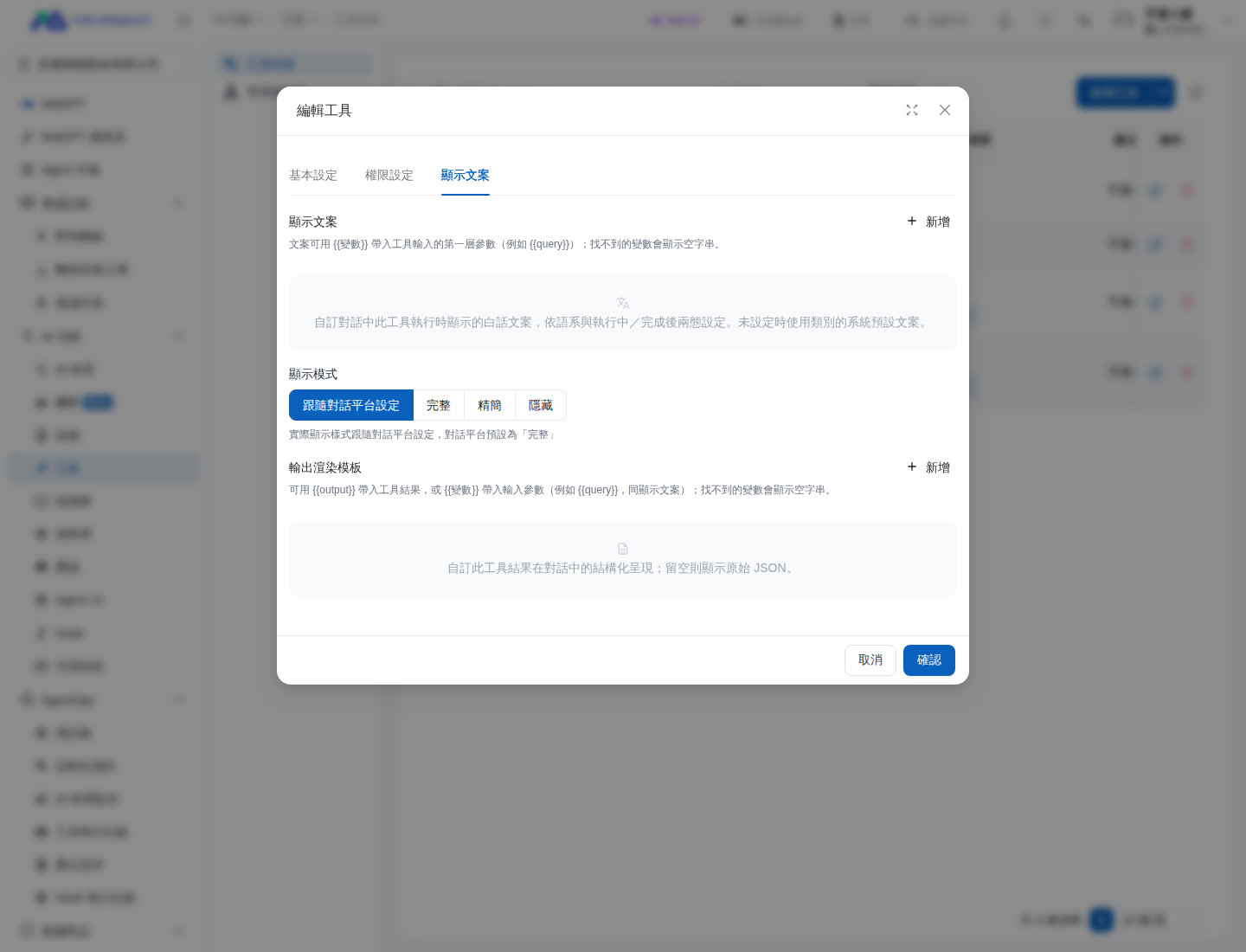
Display copy and display mode settings for a tool
{% endstep %}
{% step %}
### Select a Display Mode
Select a mode based on how much information conversation users need to see:
| Mode | Effect in the conversation |
| ------------------------------------- | ------------------------------------------------------------------------------------------- |
| Follow conversation platform settings | Uses the conversation platform's default display behavior. The current default is **Full**. |
| Full | Displays complete tool execution information. |
| Compact | Displays only concise execution information. |
| Hidden | Does not display the tool execution block. |
{% hint style="warning" %}
**Hidden** only hides the tool execution block in the conversation; it does not disable the tool. To prevent the AI assistant from calling the tool, go to the AI assistant's **Tools** settings and remove the tool from its configuration.
{% endhint %}
{% endstep %}
{% step %}
### Customize the Display Copy
In the **Display Copy** section, click Add and configure the text displayed while the tool is running and after it finishes. The copy can use `{{variable}}` to insert a top-level parameter from the tool input, such as `{{query}}`. If the variable cannot be found, an empty string is displayed.
{% endstep %}
{% step %}
### Configure the Output Rendering Template
To format the content returned by the tool, click Add in the **Output Rendering Template** section. The template can use `{{output}}` to insert the complete tool result or `{{variable}}` to insert a top-level parameter from the tool input. If the variable cannot be found, an empty string is displayed. If the template is left blank, the raw JSON is displayed.
When finished, click Confirm to save.
{% endstep %}
{% endstepper %}
## Recommendations for Selecting a Mode
* Select **Full** when users need to verify the tool results.
* Select **Compact** and provide clear display copy when users only need to know that the system is processing the request.
* Select **Hidden** when execution details should not appear in the conversation.
After completing the setup, assign the tool to a test AI assistant and send a test question. Confirm that the display copy and output template match the fields actually returned by the tool.
---
# Agent Instructions
This documentation is published with GitBook. GitBook is the documentation platform designed so that both humans and AI agents can read, navigate, and reason over technical content effectively. Learn more at gitbook.com.
## Querying This Documentation
If you need additional information that is not directly available in this page, you can query the documentation dynamically by asking a question.
Perform an HTTP GET request on the current page URL with the `ask` query parameter, and the optional `goal` query parameter:
```
GET https://docs.maiagent.ai/maiagent-user-guide/en/tools/tool-display-settings.md?ask=&goal=
```
`ask` is the immediate question: it should be specific, self-contained, and written in natural language.
`goal` is optional and describes the broader end goal you are ultimately trying to accomplish on behalf of the user. GitBook uses it to tailor the answer towards what is most useful for that goal.
The response will contain a direct answer to the question and relevant excerpts and sources from the documentation.
Use this mechanism when the answer is not explicitly present in the current page, you need clarification or additional context, or you want to retrieve related documentation sections.