> For the complete documentation index, see [llms.txt](https://docs.maiagent.ai/llms.txt). Markdown versions of documentation pages are available by appending `.md` to page URLs; this page is available as [Markdown](https://docs.maiagent.ai/maiagent-user-guide/en/serve/voicecs.md).
# Use Cases: Voice Customer Service
Voice customer service overview: the flow from voice input and ASR speech recognition to Agent processing, covering three applications: IVR intent recognition, call summaries, and call quality inspect
Modern voice customer service systems combine artificial intelligence to provide diverse and flexible solutions that improve service efficiency and customer experience. The overall flow starts with **voice input**. **ASR speech recognition** converts the customer's speech into text, and then, depending on needs, a variety of Agent capabilities can be applied for further processing.
Agents cover the following applications:
1. **Intent recognition**: Parses the content of the customer's speech to quickly understand their needs or issues, making subsequent handling easier.
2. **Summary and ticket dispatch**: For complex customer requests, generates a summary and automatically assigns it to the appropriate service department or system.
3. **Intelligent quality inspection**: Monitors and analyzes calls in real time to ensure service quality meets standards.
4. **Intelligent reply**: Generates an appropriate response based on the intent recognition result, converts it into speech using **TTS text-to-speech** technology, and replies to the customer.
These applications can be used flexibly according to actual needs. A full-flow deployment is not required; instead, design them for different scenarios and requirements. For example, some scenarios may only need intent recognition, while intelligent reply suits scenarios where real-time voice responses are desired.
Combining these application modules builds a voice customer service ecosystem that is both feature-rich and highly adaptable, enabling more efficient and personalized customer interactions. Next, we will describe in detail how to build an Agent for each application and MaiAgent's solutions, showing their technical core and application value.
```mermaid
flowchart LR
A[Voice Input] --> B[ASR Speech Recognition]
B --> E[Intent Recognition]
B --> X[Human Agent Assistant]
B --> F[Summary & Ticket Dispatch]
B --> G[Intelligent Quality Inspection]
B --> H[Intelligent Reply]
subgraph AI Assistant
E
F
G
H
X
end
H --> I[TTS Text-to-Speech]
I --> J[Voice Output]
```
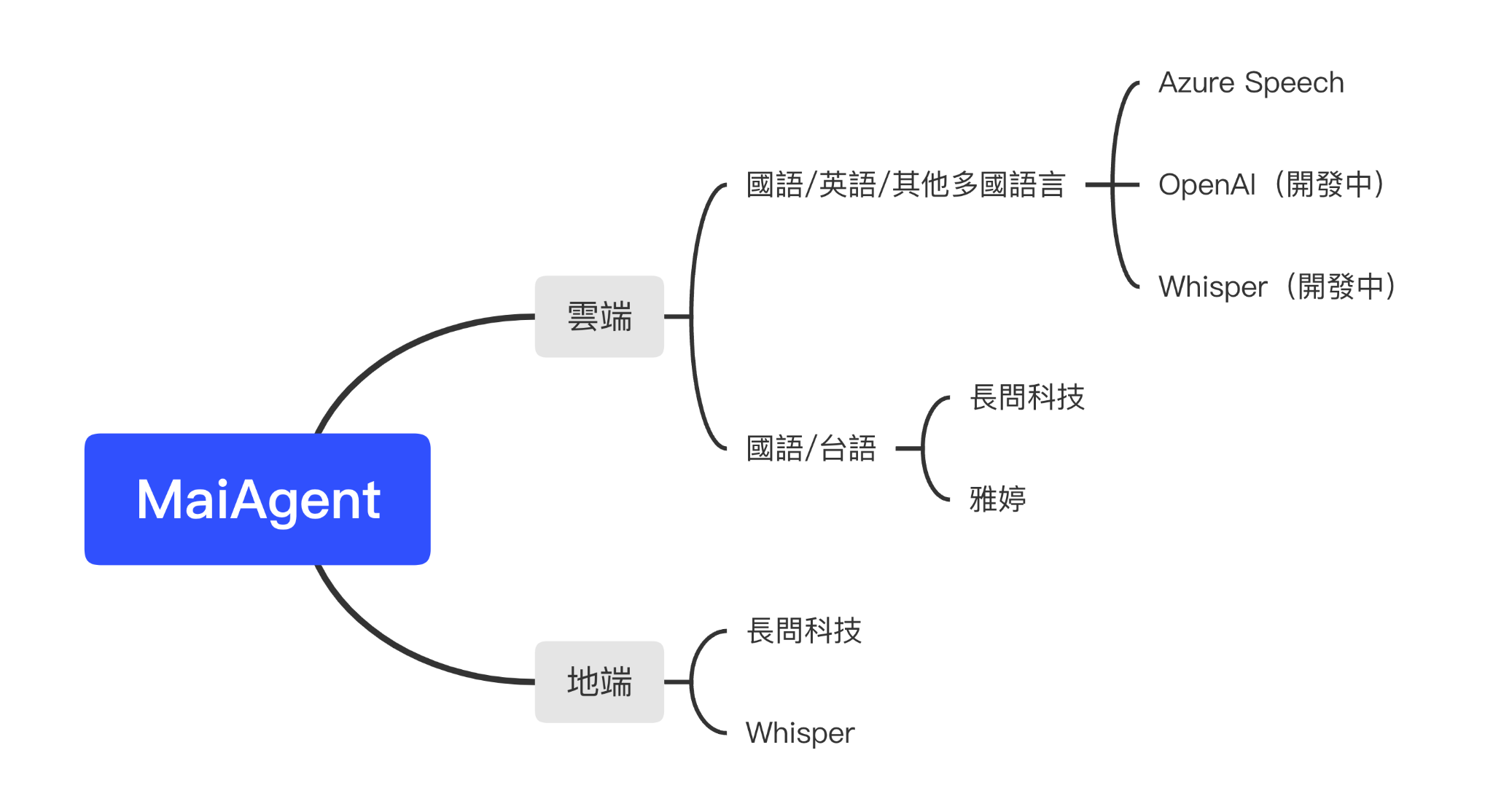
MaiAgent currently has built-in integration with a variety of ASR speech recognition and TTS speech synthesis options, so users can choose the technology that suits different scenarios.
---
# Agent Instructions
This documentation is published with GitBook. GitBook is the documentation platform designed so that both humans and AI agents can read, navigate, and reason over technical content effectively. Learn more at gitbook.com.
## Querying This Documentation
If you need additional information that is not directly available in this page, you can query the documentation by asking a question.
Perform an HTTP GET request on the following URL with the `ask` and `goal` query parameters:
```
GET https://docs.maiagent.ai/maiagent-user-guide/en/serve/voicecs.md?ask=&goal=
```
`ask` is the immediate question: it should be specific, self-contained, and written in natural language.
`goal` is what the user is ultimately trying to achieve, the reason they need the answer. Sharing it helps GitBook give you a better, more relevant answer. A goal is most helpful when it describes the outcome the user wants rather than restating the question. For example, with `ask=how do I create an API token`, a goal like `automate deployments from our CI pipeline` lets GitBook tailor the answer to that use case.
The response will contain a direct answer to the question and relevant excerpts and sources from the documentation.
Use this mechanism when the answer is not explicitly present in the current page, you need clarification or additional context, or you want to retrieve related documentation sections.