> For the complete documentation index, see [llms.txt](https://docs.maiagent.ai/llms.txt). Markdown versions of documentation pages are available by appending `.md` to page URLs; this page is available as [Markdown](https://docs.maiagent.ai/maiagent-user-guide/en/meeting-records/summary.md).

# AI Meeting Summary & Q\&A

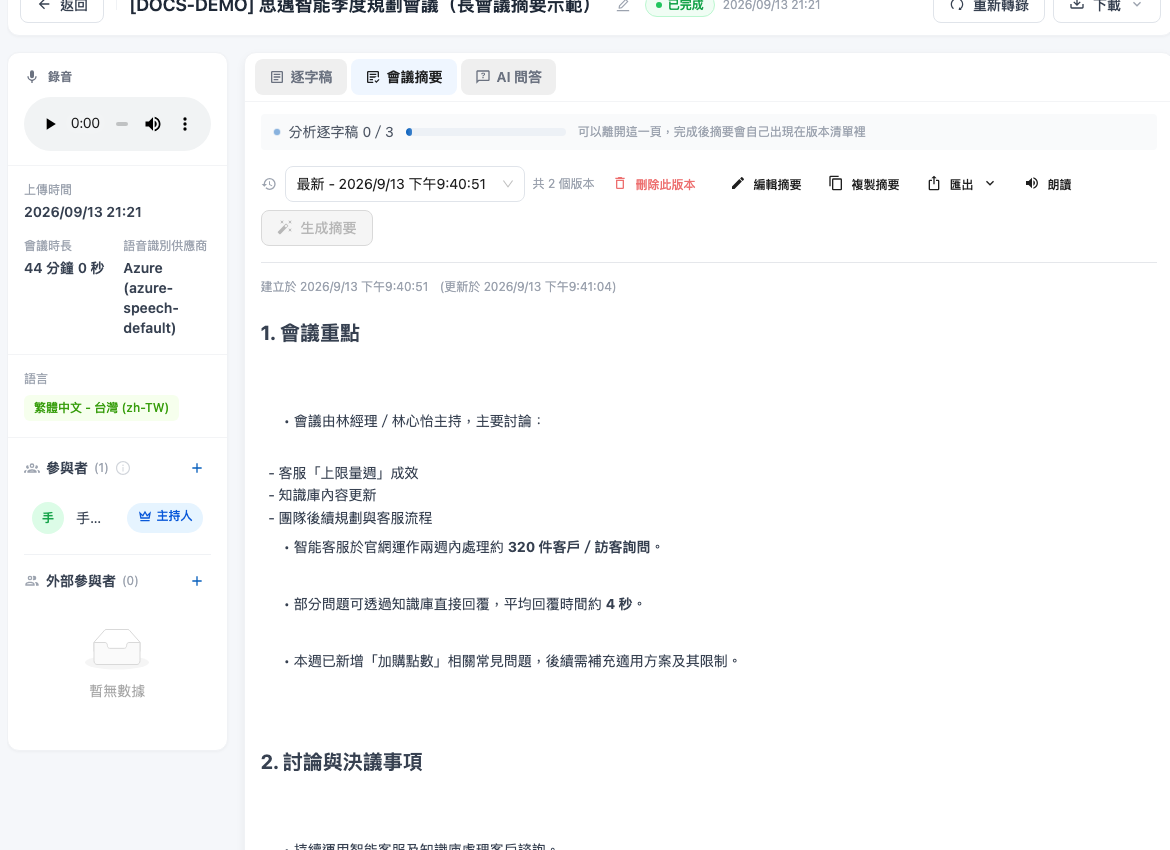
Meeting summaries are processed in the background, so you do not need to remain on the summary page while a long meeting is being processed. You can leave the page during generation and return later to check the progress. When processing is complete, the summary is created as a new version.

## Use Case <a href="#summary-scenario" id="summary-scenario"></a>

A project manager has just finished a long quarterly meeting and wants to organize the decisions before leaving work. She opens the <mark style="color:blue;">Meeting Summary</mark> tab for the meeting and starts generating a summary with the default template. After seeing that the system is analyzing the transcript, she leaves the page to work on other tasks. When she returns to the same meeting later, the page continues to display the progress. Once processing is complete, she can review the decisions and action items in the newly created summary version.

## Custom Summary Agent <a href="#custom-summary-agent" id="custom-summary-agent"></a>

The meeting records summary feature lets you select a custom AI assistant (Agent) to generate summaries. Different Agents can have different role instructions to produce summaries in different styles:

* **General Summary Agent**: Organize meeting highlights, decisions, and action items
* **Technical Meeting Agent**: Focus on technical decisions, architecture discussions, and technical debt items
* **Business Meeting Agent**: Focus on client requirements, sales progress, and opportunity tracking

## Generate a Summary <a href="#auto-generate-summary" id="auto-generate-summary"></a>

1. Go to the meeting detail page
2. Switch to the <mark style="color:blue;">Meeting Summary</mark> tab
3. To customize the summary format, select the AI assistant to generate the summary; if none is selected, the default template is used
4. Click <mark style="color:blue;">Generate Summary</mark>

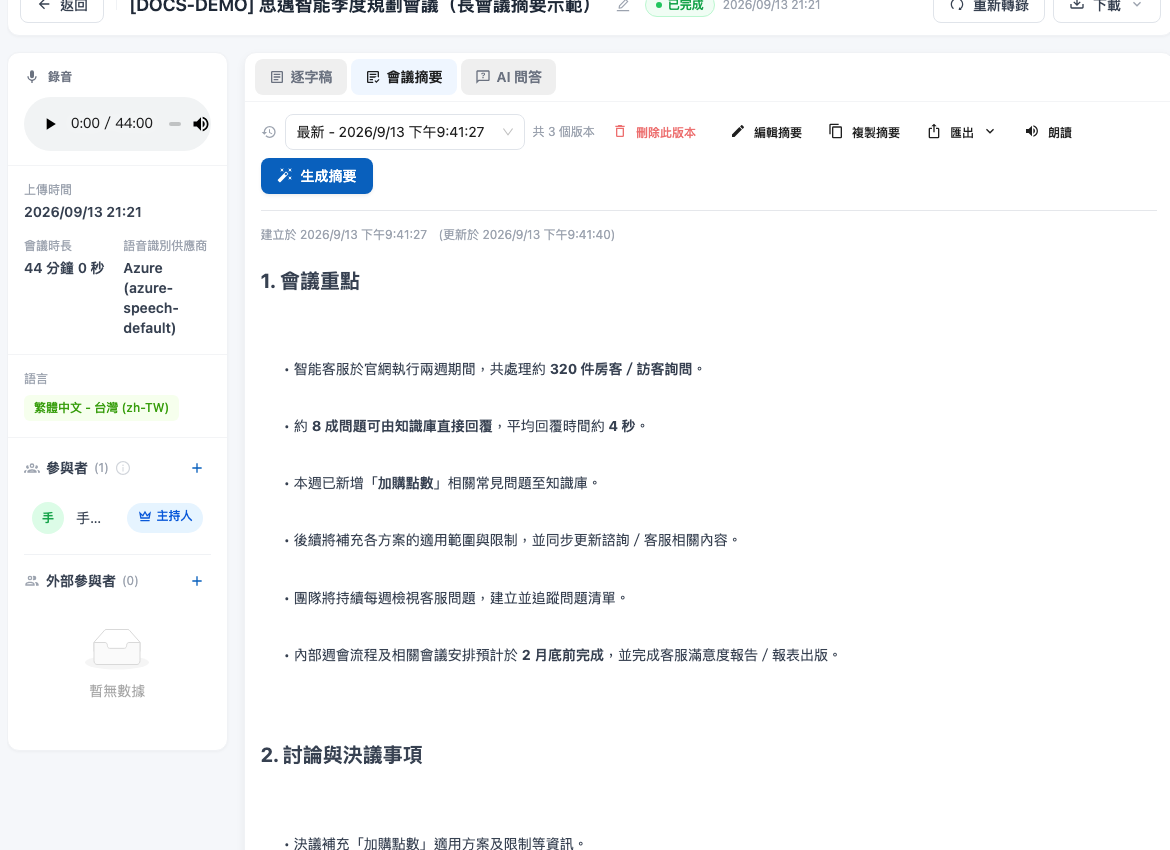
The AI uses the complete transcript to organize the meeting highlights, decisions, and action items. When you use the default template, the page displays the <mark style="color:blue;">Analyzing transcript N/M</mark> status followed by the summary compilation status. N represents the number of completed segments, and M represents the total number of segments. When you select a custom AI assistant, the assistant processes the transcript directly and the segmented N/M progress is not displayed.

Whether you use the default template or a custom AI assistant, you can leave the page while processing continues in the background. Refresh the page or return to the meeting later to see the current status.

<figure><img src="https://1360999650-files.gitbook.io/~/files/v0/b/gitbook-x-prod.appspot.com/o/spaces%2F6v6TNkkOQVfRYfcNirHL%2Fuploads%2Fgit-blob-61d8c4726b9e278842929b724ea85d69c6faa538%2Fmeeting-summary-progress.png?alt=media" alt="Meeting Summary tab for a long meeting showing Analyzing transcript 0/3 and a progress bar"><figcaption><p>Leave the page and return later to continue viewing the default template's segmented progress</p></figcaption></figure>

<figure><img src="https://1360999650-files.gitbook.io/~/files/v0/b/gitbook-x-prod.appspot.com/o/spaces%2F6v6TNkkOQVfRYfcNirHL%2Fuploads%2Fgit-blob-cbcb02b8196e7519846ac89827588c029712f6b4%2Fmeeting-detail-summary.png?alt=media" alt="Completed long-meeting summary showing the latest version and three versions in total"><figcaption><p>When the summary is complete, the new version appears in the version list</p></figcaption></figure>

{% hint style="info" %}
When the summary is complete, a new version is created automatically; you do not need to save it separately. If generation fails, the page prompts you to try again. Confirm that the transcript is available, then click <mark style="color:blue;">Regenerate</mark>.
{% endhint %}

## Summary Version Management <a href="#summary-version-management" id="summary-version-management"></a>

Each time a summary is generated or edited, the system retains a complete version history:

* **Add Summary**: Each summary generation creates a new version
* **Edit Summary**: Modify existing summary content
* **Version History**: View all summary versions and their creation times
* **Delete Summary**: Remove unwanted summary versions

## Copy a Summary <a href="#copy-summary" id="copy-summary"></a>

When viewing a saved summary, a <mark style="color:blue;">Copy Summary</mark> button appears in the toolbar above it. Use the button to copy the entire summary to the clipboard without manually selecting all the text, making it easy to paste into email, documents, or messaging apps.

1. Go to the meeting detail page and switch to the "Meeting Summary" tab
2. Select a saved summary
3. Click <mark style="color:blue;">Copy Summary</mark>
4. After the "Copied successfully" notification appears, paste it into another application

<figure><img src="https://1360999650-files.gitbook.io/~/files/v0/b/gitbook-x-prod.appspot.com/o/spaces%2F6v6TNkkOQVfRYfcNirHL%2Fuploads%2Fgit-blob-558d2684a9c9471306571d306d3a3e3d7e4663cd%2Fmeeting-summary-copy.png?alt=media" alt="Copy Summary button in the Meeting Summary tab toolbar"><figcaption><p>The toolbar in the "Meeting Summary" tab</p></figcaption></figure>

The summary's original text is copied with its paragraph structure preserved.

{% hint style="info" %} <mark style="color:blue;">Copy Summary</mark> is available only when viewing a saved summary. It does not appear while editing a summary or previewing an unsaved draft. The button is disabled when the summary is empty.
{% endhint %}

If "Copy failed" appears, the browser has usually blocked clipboard access. Select and copy the text manually instead.

## Read a Summary Aloud <a href="#read-aloud-summary" id="read-aloud-summary"></a>

When reading is inconvenient, have the system read the summary aloud. When viewing a saved summary, a <mark style="color:blue;">Read Aloud</mark> button appears in the toolbar. Click it to hear the summary.

1. Go to the meeting detail page and switch to the "Meeting Summary" tab
2. Select a saved summary
3. Click <mark style="color:blue;">Read Aloud</mark>. The button displays "Preparing…" before playback begins
4. During playback, click <mark style="color:blue;">Pause</mark> to pause, <mark style="color:blue;">Resume</mark> to continue, or <mark style="color:blue;">Stop</mark> to end playback

<figure><img src="https://1360999650-files.gitbook.io/~/files/v0/b/gitbook-x-prod.appspot.com/o/spaces%2F6v6TNkkOQVfRYfcNirHL%2Fuploads%2Fgit-blob-dbbc0c6b9faadebe54b82a231fe8b5291fc9d906%2Fmeeting-summary-read-aloud.png?alt=media" alt="Pause and Stop buttons during playback"><figcaption><p>During playback, "Read Aloud" changes to "Pause" and "Stop"</p></figcaption></figure>

Before playback, the system automatically removes Markdown symbols such as `#`, `*`, and `-` from the summary so they are not read aloud.

### Voice and Supported Languages <a href="#read-aloud-languages" id="read-aloud-languages"></a>

The voice is determined by **the meeting's spoken language or target translation language**, not by the actual language of the summary. The following seven languages are currently supported:

| Language                     | Language Code |
| ---------------------------- | ------------- |
| Traditional Chinese (Taiwan) | `zh-TW`       |
| English (United States)      | `en-US`       |
| Japanese                     | `ja-JP`       |
| Korean                       | `ko-KR`       |
| Thai                         | `th-TH`       |
| Indonesian                   | `id-ID`       |
| Vietnamese                   | `vi-VN`       |

{% hint style="warning" %}
If the meeting language is not on the list above, such as Simplified Chinese `zh-CN` or Cantonese `zh-HK`, the toolbar displays a message saying that the language is not currently supported and the default language will be used. You can still use Read Aloud, but it uses a Traditional Chinese voice.
{% endhint %}

### Limitations <a href="#read-aloud-limits" id="read-aloud-limits"></a>

* <mark style="color:blue;">Read Aloud</mark> is available only when viewing a saved summary; it does not appear while editing a summary or previewing an unsaved draft
* The button is disabled when the summary is empty
* Playback stops automatically when you switch summary versions or leave the "Meeting Summary" tab, so audio does not continue in the background
* The button is not displayed if the browser does not support audio playback
* If playback fails, "Text-to-speech failed. Please try again later" appears; try again later

## AI Q\&A <a href="#ai-qa" id="ai-qa"></a>

In addition to the summary feature, you can ask questions directly about the transcript content:

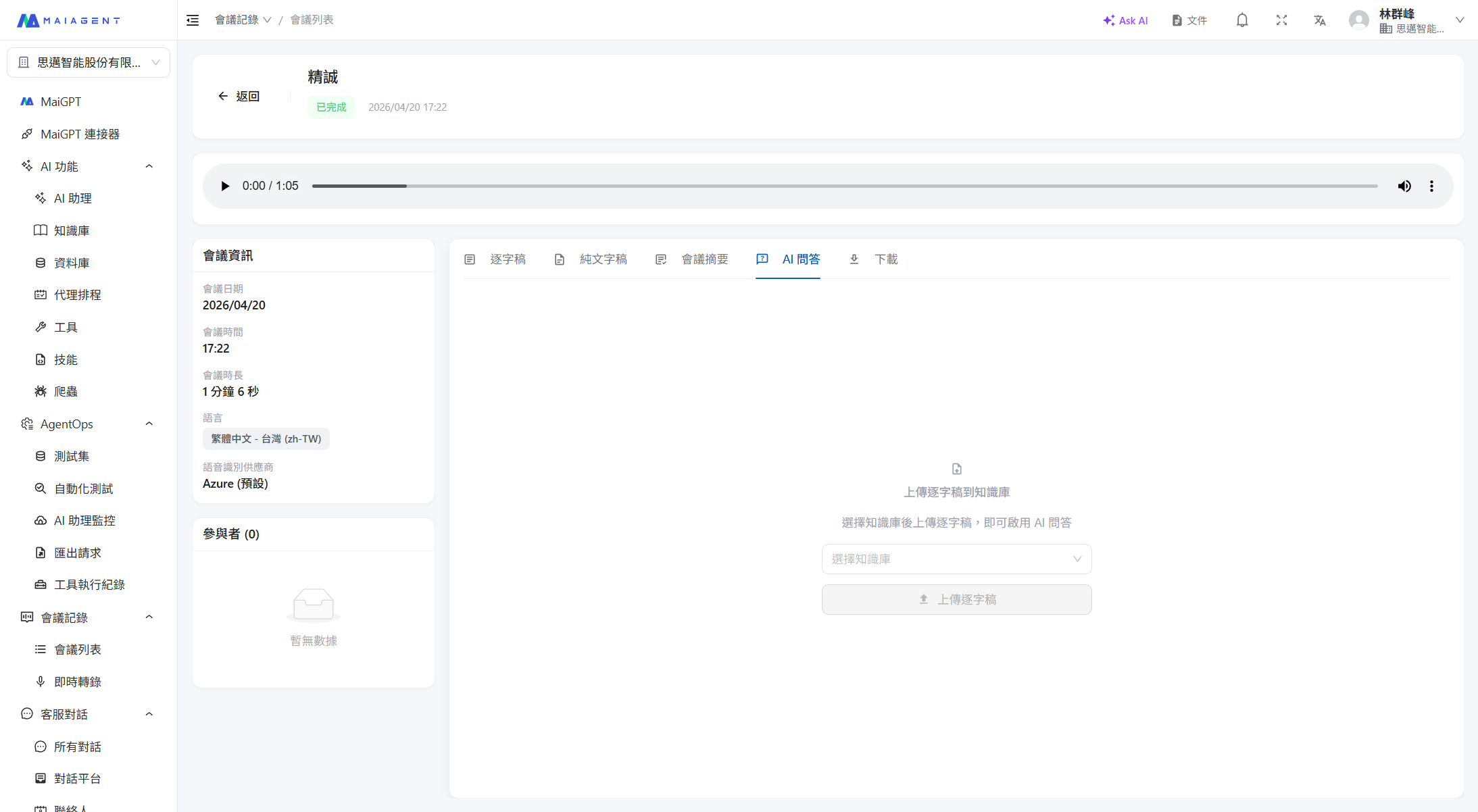
1. Switch to the "AI Q\&A" tab
2. Select the AI assistant to use
3. Enter your question (e.g., "What decisions were made in this meeting?" "What are the next action items?")
4. The AI finds relevant content from the transcript and provides an answer

This feature is especially useful for quickly reviewing specific content from long meetings without re-reading the entire transcript.

<figure><img src="https://1360999650-files.gitbook.io/~/files/v0/b/gitbook-x-prod.appspot.com/o/spaces%2F6v6TNkkOQVfRYfcNirHL%2Fuploads%2Fgit-blob-ce898c15c95c1b8c762c3798dde0e4bba8c5a1ff%2Fmeeting-detail-ai-qa.png?alt=media" alt=""><figcaption><p>AI Q&#x26;A Tab</p></figcaption></figure>

## Agent Ticket Creation <a href="#connect-agent-ticket-creation" id="connect-agent-ticket-creation"></a>

After a meeting ends, action items and decisions usually need to be manually entered into a project management or ticketing system. You can let the AI assistant handle this step: in the <mark style="color:blue;">AI Q\&A</mark> tab, ask it to turn the items discussed in the meeting directly into tasks or tickets.

{% hint style="info" %}
Meeting Records does not have a dedicated "Create Ticket" button. <mark style="color:blue;">AI Q\&A</mark> uses the full AI assistant conversation, so **as long as the selected AI assistant is configured with tools that can create tickets, you can ask it to create tickets in the conversation** — the ticket creation capability comes from the AI assistant, not from Meeting Records.
{% endhint %}

### How It Works <a href="#ticket-how-it-works" id="ticket-how-it-works"></a>

| Step                                | Details                                                                                                                   |
| ----------------------------------- | ------------------------------------------------------------------------------------------------------------------------- |
| **① Meeting Transcript**            | Meeting transcription is complete, and the transcript has been uploaded to the knowledge base and parsed                  |
| **② Select AI Assistant**           | In the <mark style="color:blue;">AI Q\&A</mark> tab, select an AI assistant configured with ticket creation tools         |
| **③ Issue Ticket Creation Command** | For example, "Compile the action items from this meeting and create a ticket for each one"                                |
| **④ AI Assistant Calls Tools**      | The assistant calls API tools or MCP tools based on the field mappings and ticket creation rules in its role instructions |
| **⑤ Create Tickets**                | Tickets are written to your company's ticketing or project management system                                              |
| **⑥ Report Results**                | The assistant reports each ticket's number and link in the conversation                                                   |

### Prerequisites <a href="#ticket-prerequisites" id="ticket-prerequisites"></a>

| Condition                                                                     | Description                                                                                                                                                                                                                                                                                                                                                                                                                                                                                                                                       |
| ----------------------------------------------------------------------------- | ------------------------------------------------------------------------------------------------------------------------------------------------------------------------------------------------------------------------------------------------------------------------------------------------------------------------------------------------------------------------------------------------------------------------------------------------------------------------------------------------------------------------------------------------- |
| **Meeting is linked to a knowledge base, and transcript parsing is complete** | <mark style="color:blue;">AI Q\&A</mark> requires the transcript to be in the knowledge base before it can be used. You can link a knowledge base when [creating a meeting](/maiagent-user-guide/en/meeting-records/create-meeting.md); if not set at that time, you can also select a knowledge base in the <mark style="color:blue;">AI Q\&A</mark> tab and click <mark style="color:blue;">Upload Transcript</mark>. See [Download and Knowledge Base Integration](/maiagent-user-guide/en/meeting-records/download-and-export.md) for details |
| **An AI assistant configured with ticket creation tools**                     | The tool, not Meeting Records, is what actually calls the ticketing system. See the setup steps below                                                                                                                                                                                                                                                                                                                                                                                                                                             |
| **Ticketing system provides a callable API**                                  | MaiAgent communicates with external systems via API tools or MCP tools, without being limited to any specific vendor; as long as the other party provides an API for creating tickets, it can be integrated                                                                                                                                                                                                                                                                                                                                       |

### Setup Steps <a href="#ticket-setup" id="ticket-setup"></a>

1. **Create a ticket creation tool**: On the <mark style="color:blue;">Tools</mark> page, click <mark style="color:blue;">Add API Tool</mark> and configure your company's ticketing system's "Create Ticket" API (you can paste a cURL command directly and the system will automatically parse the URL, headers, and HTTP method). See [Create API Tool](/maiagent-user-guide/en/tools/setup_api_tool.md) for details. If the other party provides an MCP server, you can also use [MCP Tool](/maiagent-user-guide/en/tools/mcp-setup.md) instead.
2. **Assign the tool to the AI assistant**: Add the newly created tool to the AI assistant's available tools list. See [Configure Tools for AI Assistant](/maiagent-user-guide/en/tools/configure_tools.md).
3. **Define ticket creation rules in the role instructions**: Whether the AI calls the tool at the right time and how fields are filled depends on the role instructions. Refer to the example below, and see the [Role Instructions Design Guide](/maiagent-user-guide/en/build/system-prompt.md) for writing principles.
4. **Use in meetings**: Go to the <mark style="color:blue;">AI Q\&A</mark> tab on the meeting detail page, select this AI assistant, and issue a command directly, such as "Compile the action items from this meeting and create a ticket for each one."

{% hint style="warning" %}
Ticket creation writes to an external system. It is recommended to verify field mappings with a test project or test environment before switching to your production ticketing system.
{% endhint %}

### Role Instructions Example <a href="#ticket-prompt-example" id="ticket-prompt-example"></a>

```
# Role
You are a meeting action item ticketing assistant.

# Task
Users will ask you to create tickets based on meeting transcripts. Follow this process:

1. Identify clear action items and decisions from the transcript; ignore pure discussions or items that haven't been finalized
2. Organize each action item into a ticket with the following field mappings:
   - Title: One sentence describing what needs to be done, under 30 characters
   - Content: Add the background and rationale mentioned in the meeting
   - Assignee: The person explicitly assigned in the transcript
   - Due date: The date explicitly mentioned in the transcript
3. Before calling the tool, present the compiled ticket list to the user for confirmation; only create after getting approval
4. After creation, report each ticket's number and link

# Constraints
- Only create tickets based on transcript content; do not add tasks that were not discussed
- If the assignee or due date cannot be determined from the transcript, leave blank and note it in the response; do not guess
- When the same item is mentioned multiple times in the meeting, merge into a single ticket
```

### Verification and Troubleshooting <a href="#ticket-troubleshooting" id="ticket-troubleshooting"></a>

The parameters actually received by the tool and the returned results can be viewed in AgentOps' [Tool Execution Records](/maiagent-user-guide/en/agent-ops/tool-execution-records.md) — this is the fastest way to troubleshoot ticket creation issues.

| Issue                                                          | Cause and Resolution                                                                                                                                                                           |
| -------------------------------------------------------------- | ---------------------------------------------------------------------------------------------------------------------------------------------------------------------------------------------- |
| <mark style="color:blue;">AI Q\&A</mark> is unavailable        | The meeting is not linked to a knowledge base, or the transcript is still being parsed. Select a knowledge base in the tab and upload the transcript, then try again after parsing is complete |
| AI listed the action items but did not actually create tickets | The tool was not added to the assistant's tool list, or the role instructions do not explicitly require calling the tool. Check steps 2 and 3                                                  |
| Ticket creation failed                                         | Check the error message in the tool execution records. Common causes include missing required fields, expired authentication, or insufficient permissions                                      |
| Ticket field content is incorrect                              | Make the field mapping rules more specific in the role instructions, and explicitly instruct it to leave fields blank rather than guess when information cannot be determined                  |
| AI's response is unrelated to this meeting                     | The currently selected AI assistant may not be linked to this meeting's knowledge base; the interface will show a reminder. Switch to a linked assistant                                       |


---

# Agent Instructions
This documentation is published with GitBook. GitBook is the documentation platform designed so that both humans and AI agents can read, navigate, and reason over technical content effectively. Learn more at gitbook.com.

## Querying This Documentation
If you need additional information that is not directly available in this page, you can query the documentation dynamically by asking a question.

Perform an HTTP GET request on the current page URL with the `ask` query parameter, and the optional `goal` query parameter:

```
GET https://docs.maiagent.ai/maiagent-user-guide/en/meeting-records/summary.md?ask=<question>&goal=<endgoal>
```

`ask` is the immediate question: it should be specific, self-contained, and written in natural language.
`goal` is optional and describes the broader end goal you are ultimately trying to accomplish on behalf of the user. GitBook uses it to tailor the answer towards what is most useful for that goal.

The response will contain a direct answer to the question and relevant excerpts and sources from the documentation.

Use this mechanism when the answer is not explicitly present in the current page, you need clarification or additional context, or you want to retrieve related documentation sections.