> For the complete documentation index, see [llms.txt](https://docs.maiagent.ai/llms.txt). Markdown versions of documentation pages are available by appending `.md` to page URLs; this page is available as [Markdown](https://docs.maiagent.ai/maiagent-user-guide/en/maigpt/canvas.md).

# Canvas

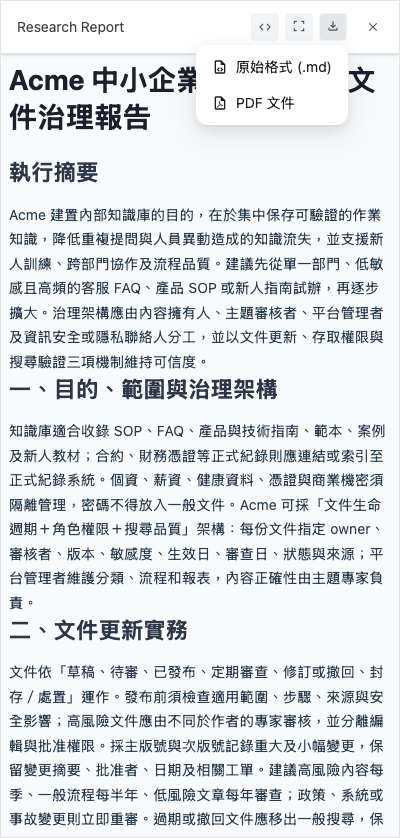
Canvas is the area MaiGPT uses to display documents and charts. When AI generates content in Canvas, you can view the result alongside the conversation and use preview, source code, and download features depending on the content type. Markdown documents currently support previewing. To edit text manually, download the file first, then open it in a text editor.

<figure><img src="https://1360999650-files.gitbook.io/~/files/v0/b/gitbook-x-prod.appspot.com/o/spaces%2F6v6TNkkOQVfRYfcNirHL%2Fuploads%2Fgit-blob-f0ff5e804996511d1c21c83ed05e0ee9ecd2030d%2Fcanvas-markdown-preview.png?alt=media" alt="Markdown document preview in Canvas"><figcaption><p>Markdown Canvas displays the document content, with source code, full-screen, and download controls in the upper-right corner</p></figcaption></figure>

***

## When to use Canvas <a href="#when-to-use-canvas" id="when-to-use-canvas"></a>

| Scenario               | Example prompt                                  |
| ---------------------- | ----------------------------------------------- |
| Write a report         | "Write a Q1 performance summary for me"         |
| Write an email         | "Help me reply to this customer's inquiry"      |
| Organize meeting notes | "Format the following content as meeting notes" |
| Draw a flowchart       | "Draw a leave request flowchart"                |
| Create a table         | "Create a table comparing Plan A and Plan B"    |

***

## How to use it <a href="#how-to-use" id="how-to-use"></a>

### Open Canvas <a href="#open-canvas" id="open-canvas"></a>

AI automatically opens Canvas when generating longer documents. You can also ask it directly:

> "Use Canvas to write a..."

### Edit content <a href="#edit-content" id="edit-content"></a>

After Canvas opens, you can:

1. **View the document** — Read the content in Markdown Canvas. Switch to source code mode to view the Markdown text; this mode is not a text-editing field.
2. **Download and edit** — Download the Markdown file, then edit it in a text editor. Changes to the local file are not automatically written back to Canvas.
3. **Request changes** — Clearly specify the paragraph you want to adjust in the conversation, such as "Make the second paragraph more concise."

### Export <a href="#export" id="export"></a>

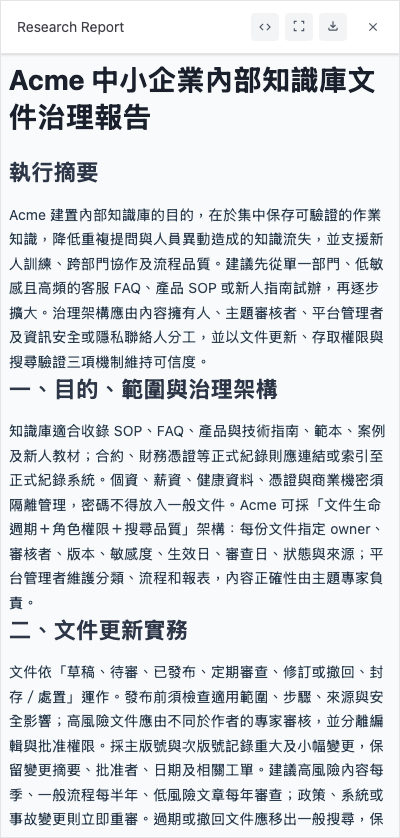
The upper-right corner of Markdown Canvas provides a <mark style="color:blue;">Download</mark> menu:

* **Original format (.md)** — Save the Markdown file so you can edit it in a text editor
* **PDF document** — Download a PDF for reading and sharing

To copy the Markdown text, switch to code mode, then use the copy button in the content area.

***

## What Canvas can create <a href="#what-canvas-can-create" id="what-canvas-can-create"></a>

| Type          | Suitable for                                       | Example                                        |
| ------------- | -------------------------------------------------- | ---------------------------------------------- |
| **Documents** | Reports, emails, proposals, announcements          | "Write a new product launch announcement"      |
| **Tables**    | Comparative analysis, data organization            | "Compare quotes from three vendors"            |
| **Charts**    | Flowcharts, organization charts, sequence diagrams | "Draw the customer complaint handling process" |

***

## Tips <a href="#tips" id="tips"></a>

{% hint style="success" %}
**Let AI help you iterate**

You do not need to get everything right on the first try. Ask AI to create an initial version, then refine it step by step:

1. "Write an initial draft"
2. "Make the tone more formal"
3. "Add supporting data"
4. "Turn the last paragraph into a call to action"
   {% endhint %}

{% hint style="info" %}
**Keep the versions you need**

Download the file first when you need to preserve the current content. Markdown Canvas preview and source code modes do not support direct text editing; edit the downloaded local file instead.
{% endhint %}

***

## Write documents <a href="#write-documents" id="write-documents"></a>

You can ask AI to write reports, emails, proposals, announcements, or meeting notes, then view the result in Canvas. You can download Markdown documents and edit them manually.

### Quick start <a href="#quick-start" id="quick-start"></a>

Tell AI directly what you want to write:

> "Write a reply to a customer's request for a quote"
>
> "Use Canvas to organize today's meeting notes"
>
> "Write an internal announcement for a new feature launch"

After AI generates the document in Canvas, you can open the preview and download the result.

### Edit and revise <a href="#edit-and-revise" id="edit-and-revise"></a>

#### Edit manually after downloading <a href="#direct-edit" id="direct-edit"></a>

Unlike Word, Markdown Canvas does not let you click text to edit it directly. Use the download menu in the upper-right corner to save the Markdown file, then open it in a text editor. Source code mode is only for viewing and copying.

#### Ask AI to make changes <a href="#ai-assisted-edit" id="ai-assisted-edit"></a>

Enter clear revision instructions in the conversation, such as:

| You say                                                  | AI does                                  |
| -------------------------------------------------------- | ---------------------------------------- |
| "Make the tone more formal"                              | Adjusts the tone throughout the document |
| "The second paragraph is too long. Make it more concise" | Shortens the specified paragraph         |
| "Add a paragraph about the schedule"                     | Adds a paragraph                         |
| "Convert it to a bulleted list"                          | Reformats the content                    |
| "Translate it into English"                              | Translates the entire document           |

<figure><img src="https://1360999650-files.gitbook.io/~/files/v0/b/gitbook-x-prod.appspot.com/o/spaces%2F6v6TNkkOQVfRYfcNirHL%2Fuploads%2Fgit-blob-feb7783cf407a43f54775edab716d4327a0e9cf4%2Fcanvas-markdown-download.png?alt=media" alt="Markdown Canvas download menu"><figcaption><p>The download menu provides the original Markdown format and PDF</p></figcaption></figure>

### Common document templates <a href="#document-templates" id="document-templates"></a>

Try these prompts to quickly create common documents:

| Document type     | Example prompt                                                                                                   |
| ----------------- | ---------------------------------------------------------------------------------------------------------------- |
| **Weekly report** | "Write this week's report. Highlights: completed Project A, started Requirement B, and will work on C next week" |
| **Email**         | "Write an email politely but clearly declining a vendor's quote"                                                 |
| **Meeting notes** | "Format the following content as meeting notes: (paste notes)"                                                   |
| **Proposal**      | "Write an outline for a proposal to introduce AI customer service, including a benefits analysis"                |
| **Announcement**  | "Write a system maintenance announcement for Saturday from 2:00 to 6:00 a.m."                                    |

### Export documents <a href="#export-document" id="export-document"></a>

See [Export](#export) above for how to download and copy Markdown documents. You can edit downloaded local files with the appropriate tools.

***

## Create charts <a href="#create-charts" id="create-charts"></a>

Describe what you need in natural language, and AI can create flowcharts, organization charts, sequence diagrams, and other charts for you in Canvas. You do not need to learn any syntax—simply say what you want to draw.

### Quick start <a href="#chart-quick-start" id="chart-quick-start"></a>

Tell AI directly what you want to draw:

> "Draw a leave request flowchart"
>
> "Draw our department's organization chart"
>
> "Draw the process from a user placing an order to shipment"

### Supported chart types <a href="#supported-chart-types" id="supported-chart-types"></a>

| Chart type             | Example prompt                                  | Purpose                          |
| ---------------------- | ----------------------------------------------- | -------------------------------- |
| **Flowchart**          | "Draw the reimbursement process"                | Steps and decision branches      |
| **Organization chart** | "Draw the department structure"                 | Reporting relationships          |
| **Sequence diagram**   | "Draw a sequence diagram for API calls"         | Sequence of system interactions  |
| **Gantt chart**        | "Draw a Gantt chart for the project schedule"   | Project scheduling               |
| **Mind map**           | "Organize the marketing strategy as a mind map" | Brainstorming and categorization |

### Edit charts <a href="#edit-chart" id="edit-chart"></a>

Want to make changes after the chart is generated? Just say what you need:

| You say                                          | AI does               |
| ------------------------------------------------ | --------------------- |
| "Add an approval step after the second step"     | Adds a node           |
| "Change the flowchart to run from left to right" | Adjusts the direction |
| "Remove the last step"                           | Deletes the node      |
| "Change the colors to shades of blue"            | Adjusts the style     |

### Export charts <a href="#export-chart" id="export-chart"></a>

When finished, you can:

* **Copy** — Paste into a presentation or document
* **Take a screenshot** — Capture the chart directly in Canvas

***

## Next steps <a href="#next-steps" id="next-steps"></a>

* [Deep Research](/maiagent-user-guide/en/maigpt/deep-research.md)
* [Back to MaiGPT overview](/maiagent-user-guide/en/maigpt/maigpt.md)


---

# Agent Instructions
This documentation is published with GitBook. GitBook is the documentation platform designed so that both humans and AI agents can read, navigate, and reason over technical content effectively. Learn more at gitbook.com.

## Querying This Documentation
If you need additional information that is not directly available in this page, you can query the documentation dynamically by asking a question.

Perform an HTTP GET request on the current page URL with the `ask` query parameter, and the optional `goal` query parameter:

```
GET https://docs.maiagent.ai/maiagent-user-guide/en/maigpt/canvas.md?ask=<question>&goal=<endgoal>
```

`ask` is the immediate question: it should be specific, self-contained, and written in natural language.
`goal` is optional and describes the broader end goal you are ultimately trying to accomplish on behalf of the user. GitBook uses it to tailor the answer towards what is most useful for that goal.

The response will contain a direct answer to the question and relevant excerpts and sources from the documentation.

Use this mechanism when the answer is not explicitly present in the current page, you need clarification or additional context, or you want to retrieve related documentation sections.