> For the complete documentation index, see [llms.txt](https://docs.maiagent.ai/llms.txt). Markdown versions of documentation pages are available by appending `.md` to page URLs; this page is available as [Markdown](https://docs.maiagent.ai/maiagent-user-guide/en/build/conversation-settings/platform-settings/function-settings.md).

# Feature Settings

Feature settings for chat channels, including basic features, AI interaction, Hook processing markers, question option display modes, AI awareness (system time, sender name, and location), and time zo

<mark style="color:blue;">Feature Settings</mark> has the most switches of any category on the chat channel settings page. It determines what users can do and see in a conversation, as well as what the AI knows when answering. Web and API channels have all five sections. Internal channels do not have “Question Option Display Mode”; messaging channels such as LINE and Microsoft Teams only have “AI Interaction” (<mark style="color:blue;">Enable OCR</mark>, <mark style="color:blue;">Reply Only When @Mentioned</mark>, and [platform-specific switches](#messaging-platform-switches)) and “AI Awareness”.

{% hint style="info" %}
**Solution guide**: This page covers one step in configuring a chat channel. For the complete text customer service launch process, see [Text Customer Service: From Setup to Launch](https://docs.maiagent.ai/maiagent-user-guide/en/serve/text-service.md).
{% endhint %}

{% hint style="warning" %}
These settings **belong to each chat channel, rather than to the Agent**. If the same Agent connects to both a website and LINE, configure each channel separately. For the settings page structure and how to access it, see [Chat Channel Settings Overview](https://docs.maiagent.ai/maiagent-user-guide/en/build/conversation-settings/platform-settings.md).
{% endhint %}

## 1. When to Use These Settings <a href="#when-to-use" id="when-to-use"></a>

A clinic uses an Agent on LINE to answer appointment questions. A patient asks, “Can I still book an appointment this afternoon?” but the Agent responds, “What is today's date?” The administrator opens <mark style="color:blue;">Feature Settings</mark> for the LINE channel, turns on <mark style="color:blue;">Use System Time in Responses</mark>, keeps the time zone as Asia/Taipei, and clicks <mark style="color:blue;">Save</mark>. Asked again, the Agent answers directly: “Today is Friday. Afternoon consultations start at 14:00, and appointments are still available.” No changes to the Agent's role instructions are needed.

## 2. Basic Features <a href="#basic-functions" id="basic-functions"></a>

<figure><img src="https://1360999650-files.gitbook.io/~/files/v0/b/gitbook-x-prod.appspot.com/o/spaces%2F6v6TNkkOQVfRYfcNirHL%2Fuploads%2Fgit-blob-0c70e66268aa842a00483f1b0317c79433f6d409%2Fplatform-function-settings-handoff-context-usage.png?alt=media" alt="Basic Features section of a web channel&#x27;s Feature Settings, with six switches: Enabled, Allow File Uploads, Allow Conversation Sharing, Allow Font Size Changes, Enable Conversation Handoff, and Show Context Usage"><figcaption><p>Web channel Feature Settings: the last row of “Basic Features” contains “Enable Conversation Handoff” and “Show Context Usage”</p></figcaption></figure>

| Switch                          | Description                                                                                                                                                                                                                                                                                                                                                                                                                                                                                                            |
| ------------------------------- | ---------------------------------------------------------------------------------------------------------------------------------------------------------------------------------------------------------------------------------------------------------------------------------------------------------------------------------------------------------------------------------------------------------------------------------------------------------------------------------------------------------------------- |
| **Enabled**                     | Turning this off stops the channel from serving users. Users can open the chat page but cannot send messages                                                                                                                                                                                                                                                                                                                                                                                                           |
| **Allow File Uploads**          | Users can upload images or files in the conversation for AI analysis                                                                                                                                                                                                                                                                                                                                                                                                                                                   |
| **Allow Conversation Sharing**  | Users can generate a sharing link for a conversation                                                                                                                                                                                                                                                                                                                                                                                                                                                                   |
| **Show Connected Services**     | Controls whether <mark style="color:blue;">Connected Services</mark> (the link icon) appears in the Web Chat title bar. When enabled, identified visitors can view, reauthorize, or disconnect external services that the Agent accesses on their behalf. When disabled, the button is hidden from all visitors. It is off by default for new channels; channels that existed before this switch was introduced keep it on. See [Show Connected Services](#show-connected-services)                                    |
| **Allow Font Size Changes**     | Provides a font size selector in the chat window                                                                                                                                                                                                                                                                                                                                                                                                                                                                       |
| **Enable Conversation Handoff** | When MaiAgent's global conversation handoff feature is enabled, this channel's Web Chat shows a handoff banner starting at 80% context usage and can generate a handoff summary card. The global switch is not available in the admin console; contact MaiAgent to enable it. If the global feature is off, turning on this switch produces no visible change. Off by default. See [Conversation Handoff](https://docs.maiagent.ai/maiagent-user-guide/en/work/maigpt/chat/conversation-handoff.md#enable-on-web-chat) |
| **Show Context Usage**          | Displays the context usage percentage below the input box in this channel's Web Chat. Independent of conversation handoff, so either feature can be enabled on its own. Off by default                                                                                                                                                                                                                                                                                                                                 |

{% hint style="info" %} <mark style="color:blue;">Enable Conversation Handoff</mark> and <mark style="color:blue;">Show Context Usage</mark> appear only for web and API channels. The internal channel's settings page does not show these switches. MaiGPT requires no configuration: context usage is always displayed, and conversation handoff follows the global switch. See [Conversation Handoff](https://docs.maiagent.ai/maiagent-user-guide/en/work/maigpt/chat/conversation-handoff.md) for how these features work in a conversation.
{% endhint %}

### Show Connected Services <a href="#show-connected-services" id="show-connected-services"></a>

[Connected Services](https://docs.maiagent.ai/maiagent-user-guide/en/build/choose-channel/web-chat/connected-services.md) lets Web Chat visitors manage their own external service authorizations. If the Agent has no OAuth tools that require individual visitor authorization, visitors will see an empty list when they open it. You can hide the button in this case.

* **Where to configure it**: <mark style="color:blue;">Feature Settings</mark> → <mark style="color:blue;">Basic Features</mark> → <mark style="color:blue;">Show Connected Services</mark>, after <mark style="color:blue;">Allow Conversation Sharing</mark>. This switch is available for web and API channels, but not internal channels.
* **Default**: Off for newly created channels, whether added in the admin console, generated when creating an Agent, or created through the API. Channels that existed before the switch was introduced keep it on, so visitors see no change.
* **Who can see it when enabled**: Only identified visitors (logged in, or identified by the website through a Source ID). Completing a Pre-chat form alone does not count as identification. It remains hidden for anonymous visitors, the floating window in the lower-right corner, and MaiGPT window mode.
* **Authorizations are unaffected**: Turning it off only hides the entry point. Authorization cards still appear in the conversation when the Agent needs authorization, and visitors' existing authorizations are not revoked.

<figure><img src="https://1360999650-files.gitbook.io/~/files/v0/b/gitbook-x-prod.appspot.com/o/spaces%2F6v6TNkkOQVfRYfcNirHL%2Fuploads%2Fgit-blob-8902749d161a0d2e34bff2a860b6a771069bb008%2Fplatform-function-settings-connected-services.png?alt=media" alt="Basic Features section of a web channel&#x27;s Feature Settings, with the enabled Show Connected Services switch to the right of Allow Conversation Sharing"><figcaption><p>“Show Connected Services” appears after “Allow Conversation Sharing”</p></figcaption></figure>

For example, an insurance company's website support Agent only answers questions about policy terms and has no connected services requiring customers' personal authorization. A logged-in policyholder clicks the link icon in the Web Chat title bar, finds no services listed, and assumes the system is broken. The support manager opens the web channel's <mark style="color:blue;">Feature Settings</mark>, turns off <mark style="color:blue;">Show Connected Services</mark>, and clicks <mark style="color:blue;">Save</mark>. After the policyholder refreshes the page, the button disappears from the title bar. If the Agent later adds a calendar tool requiring policyholder authorization, the manager can turn it back on.

### Defaults and Permissions for “Enabled” <a href="#activation-default-and-permission" id="activation-default-and-permission"></a>

* **Who can change it**: Members who can edit this chat channel can change <mark style="color:blue;">Enabled</mark>. Their role must have <mark style="color:blue;">Chat Channel Permissions</mark> and <mark style="color:blue;">Edit</mark> access to this channel under <mark style="color:blue;">Assign Chat Channels</mark>. Members with read-only access cannot change it. See [Role Permission Management](https://docs.maiagent.ai/maiagent-user-guide/en/org/roles/role-permission.md#assign-inboxes) and [Role Resource Visibility Control](https://docs.maiagent.ai/maiagent-user-guide/en/org/roles/group-resource-visibility.md) for configuration details.
* **Default state for new Agents**: When creating an Agent, use [Channel Activation](https://docs.maiagent.ai/maiagent-user-guide/en/build/agent/setup.md#channel-activation) in the creation dialog to decide whether to enable web and API channels. The switches initially follow the organization settings. New Agents created by other methods, such as duplication, apply the organization settings directly. By default, only the internal channel is enabled for new Agents; web and API channels start disabled. Members with “Organization Overview Permissions” can change this to enabled by default under [Edit Organization](https://docs.maiagent.ai/maiagent-user-guide/en/org/overview/organization-overview.md#new-agent-channel-default). Changes affect only Agents created or duplicated afterward. Existing Agents retain their current state, and internal channels are always enabled.
* **What visitors see when disabled**: Web Chat immediately displays “This page is temporarily unavailable” without first asking visitors to log in or complete a pre-chat form.

## 3. AI Interaction <a href="#ai-interaction" id="ai-interaction"></a>

| Switch                                              | Description                                                                                                                                                                                                                                                                                                                                                                                                                                                                                                                            |
| --------------------------------------------------- | -------------------------------------------------------------------------------------------------------------------------------------------------------------------------------------------------------------------------------------------------------------------------------------------------------------------------------------------------------------------------------------------------------------------------------------------------------------------------------------------------------------------------------------- |
| **Show Cited Documents**                            | Lists the knowledge base sources referenced in AI answers. Users can click citation nodes to view document excerpts                                                                                                                                                                                                                                                                                                                                                                                                                    |
| **Allow Cited Document Downloads**                  | Users can download cited files                                                                                                                                                                                                                                                                                                                                                                                                                                                                                                         |
| **Enable OCR**                                      | Recognizes text in uploaded images so the AI can read screenshots or scanned documents                                                                                                                                                                                                                                                                                                                                                                                                                                                 |
| **Show Thinking Process**                           | Displays the AI's reasoning process in the conversation                                                                                                                                                                                                                                                                                                                                                                                                                                                                                |
| **Allow Users to Adjust Thinking Effort**           | Users can adjust the AI's thinking depth in the chat window. To display the thinking effort button, you must **also enable “Show Thinking Process”**, and the Agent's model must support thinking. Set the Agent's default level under [Create an Agent: Set Thinking Effort](https://docs.maiagent.ai/maiagent-user-guide/en/build/agent/setup.md#thinking-effort). For how “Default” behaves in the user menu, see [MaiGPT Chat: Thinking Effort](https://docs.maiagent.ai/maiagent-user-guide/en/work/maigpt/chat.md#deep-thinking) |
| **Show Knowledge Base File and FAQ Selection List** | Available only for internal channels and enabled by default. Members can select files and FAQs from the Agent's associated knowledge bases in an internal conversation to limit the scope of the current query. The Agent searches only the selected items. When disabled, the list is hidden and the Agent searches all associated knowledge bases                                                                                                                                                                                    |

<figure><img src="https://1360999650-files.gitbook.io/~/files/v0/b/gitbook-x-prod.appspot.com/o/spaces%2F6v6TNkkOQVfRYfcNirHL%2Fuploads%2Fgit-blob-cf55d79da78aa33d7ff99449439a86bc807ccced%2F%E4%B8%8B%E8%BC%89%E6%96%87%E4%BB%B6display.png?alt=media" alt="Chat window showing cited documents and download buttons"><figcaption><p>Conversation with “Show Cited Documents” and “Allow Cited Document Downloads” enabled</p></figcaption></figure>

Choose whether to expose citation information based on your use case: public customer service can show all citations to build trust; internal support can disable downloads to protect confidential documents; educational institutions can display learning resources for students to consult.

### The Web Chat Thinking Effort Button <a href="#web-chat-thinking-effort" id="web-chat-thinking-effort"></a>

The thinking effort button appears below the Web Chat input box only when all three conditions are met: <mark style="color:blue;">Show Thinking Process</mark> is enabled, <mark style="color:blue;">Allow Users to Adjust Thinking Effort</mark> is enabled, and the Agent's model supports thinking.

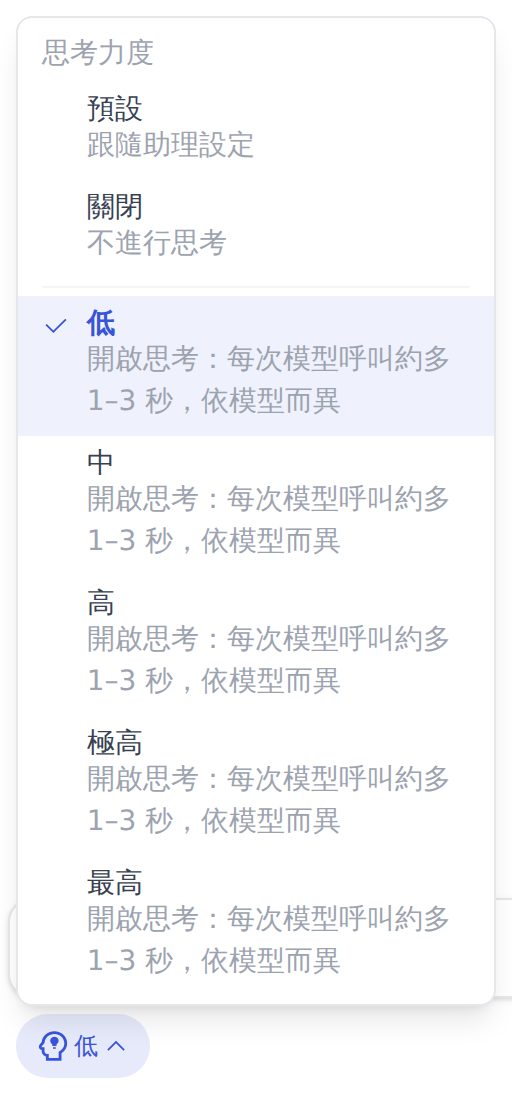
The button shows the level currently applied to the conversation. Open it to see <mark style="color:blue;">Default</mark> and <mark style="color:blue;">Off</mark> at the top (“Off” appears only when the model allows thinking to be disabled), followed by the levels supported by the Agent's model. Once a visitor selects a level, subsequent responses in that conversation use it. Set the Agent's own default level under [Create an Agent: Set Thinking Effort](https://docs.maiagent.ai/maiagent-user-guide/en/build/agent/setup.md#thinking-effort).

When the Agent has a default level configured, “Follow assistant settings” appears below <mark style="color:blue;">Default</mark>. If no level is configured, <mark style="color:blue;">Default</mark> is labeled <mark style="color:blue;">Default (No thinking · Fastest)</mark> or <mark style="color:blue;">Default (Model decides when to think)</mark> according to the model's actual behavior. See [MaiGPT Chat: Thinking Effort](https://docs.maiagent.ai/maiagent-user-guide/en/work/maigpt/chat.md#deep-thinking). All thinking levels have the description “Enable thinking: adds about 1–3 seconds per model call, depending on the model.”

<figure><img src="https://1360999650-files.gitbook.io/~/files/v0/b/gitbook-x-prod.appspot.com/o/spaces%2F6v6TNkkOQVfRYfcNirHL%2Fuploads%2Fgit-blob-8996a41a29e59f76f010f4d0f5ca4f5c196551ea%2Fwebchat-thinking-effort-menu.png?alt=media" alt="Web Chat thinking effort menu: Default (Follow assistant settings), Off (No thinking), and Low, Medium, High, Very High, and Maximum, each with the description ‘Enable thinking: adds about 1–3 seconds per model call, depending on the model.’ Low is currently selected"><figcaption><p>Web Chat thinking effort menu: when the Agent has a configured level, “Default” shows “Follow assistant settings”</p></figcaption></figure>

### Messaging Platform-Specific Switches <a href="#messaging-platform-switches" id="messaging-platform-switches"></a>

On messaging channels such as LINE, Telegram, Microsoft Teams, Slack, and Viber, the “AI Interaction” section of the <mark style="color:blue;">Feature Settings</mark> tab includes <mark style="color:blue;">Enable OCR</mark> and additional switches based on platform capabilities:

| Switch                                                           | Platforms                                                                                                                          | Description                                                                                                                                                                                                                                                                                                                                                                                                       |
| ---------------------------------------------------------------- | ---------------------------------------------------------------------------------------------------------------------------------- | ----------------------------------------------------------------------------------------------------------------------------------------------------------------------------------------------------------------------------------------------------------------------------------------------------------------------------------------------------------------------------------------------------------------- |
| <mark style="color:blue;">Reply Only When @Mentioned</mark>      | Platforms with group chats (LINE, Telegram, etc.; corresponding options are available when creating Slack and LINE WORKS channels) | Replies in groups only when @mentioned; one-to-one conversations are unaffected                                                                                                                                                                                                                                                                                                                                   |
| <mark style="color:blue;">AI Assistant Thinking Animation</mark> | LINE                                                                                                                               | Enabled by default. Shows LINE's “thinking” loading animation while the AI generates a response after the user sends a message. Works only in one-to-one chats, not groups. For LINE, this switch is on the <mark style="color:blue;">Basic Settings</mark> tab. See [LINE: AI Assistant Thinking Animation](https://docs.maiagent.ai/maiagent-user-guide/en/build/choose-channel/line.md#line-loading-animation) |
| <mark style="color:blue;">Enable Typing Indicator</mark>         | Telegram                                                                                                                           | Shows Telegram's native “typing…” indicator while the bot processes a response                                                                                                                                                                                                                                                                                                                                    |
| <mark style="color:blue;">Waiting Message</mark>                 | Microsoft Teams, Slack, Telegram, Viber                                                                                            | Sends a text notification while the AI is still processing. See the table below                                                                                                                                                                                                                                                                                                                                   |

**Waiting Message** fields:

| Field                                                                                    | Description                                                                                                                                                                                 |
| ---------------------------------------------------------------------------------------- | ------------------------------------------------------------------------------------------------------------------------------------------------------------------------------------------- |
| <mark style="color:blue;">Enable Waiting Message</mark>                                  | Sends a notification after the user sends a message while the AI is still processing                                                                                                        |
| <mark style="color:blue;">Message Text</mark>                                            | Required when enabled, for example, “AI is processing. Please wait...”                                                                                                                      |
| <mark style="color:blue;">Initial Delay in Seconds</mark>                                | Seconds to wait before sending the first notification. Recommended: 1–3 seconds. If the delay is too short and the AI responds quickly, the notification can be unnecessary                 |
| <mark style="color:blue;">Repeat Interval in Seconds</mark>                              | Updates the notification text at this interval while the AI is still processing, including the elapsed seconds                                                                              |
| <mark style="color:blue;">Automatically Delete Waiting Messages After AI Response</mark> | Deletes earlier notifications after the AI response is sent. Works only on platforms that support message deletion (Teams, Slack, Telegram). Viber notifications remain in the conversation |

{% hint style="info" %}
Web channels do not have these switches. The Web Chat waiting experience is controlled by [Response Loading Appearance](https://docs.maiagent.ai/maiagent-user-guide/en/build/conversation-settings/platform-settings/loading-display.md).
{% endhint %}

## 4. Hook Processing Markers <a href="#hook-markers" id="hook-markers"></a>

Enable <mark style="color:blue;">Show Hook Processing Markers</mark> to display a marker in the conversation when a message is processed by a Hook, such as when sensitive information is masked. You can customize the marker text. For Hook configuration, see [Hook Message Interception](https://docs.maiagent.ai/maiagent-user-guide/en/build/hook.md).

## 5. Tool Display Mode (Moved to Response Loading Appearance) <a href="#tool-display-mode" id="tool-display-mode"></a>

Configure tool display mode (full, compact, or hidden tool cards when the AI calls a tool) on the same settings page under <mark style="color:blue;">Response Loading Appearance</mark> → <mark style="color:blue;">When Calling Tools</mark>. It is grouped with tool execution messages and the “Calling tools” asset for the brand animation. See [Response Loading Appearance: When Calling Tools](https://docs.maiagent.ai/maiagent-user-guide/en/build/conversation-settings/platform-settings/loading-display.md#narrative-tool-display).

## 6. Question Option Display Mode <a href="#ask-option-display-mode" id="ask-option-display-mode"></a>

After the built-in <mark style="color:blue;">Agent UI Question Tool</mark> is configured for an Agent, it can ask users questions during a conversation. For example, it can ask “Which topic would you like to explore?” with several options, then respond based on the user's selection. This section determines how these options appear in Web Chat. Choose one of the two cards; your selection is applied when you click <mark style="color:blue;">Save</mark> for the page:

| Mode                 | Effect in the Chat Window                                                                                                                     |
| -------------------- | --------------------------------------------------------------------------------------------------------------------------------------------- |
| **Floating Buttons** | Options float in a row above the input box, which remains available. Typing and sending a message directly is treated as ignoring the options |
| **Option Panel**     | A panel of options covers the input area. The input box becomes available again after the user answers or closes the panel                    |

<figure><img src="https://1360999650-files.gitbook.io/~/files/v0/b/gitbook-x-prod.appspot.com/o/spaces%2F6v6TNkkOQVfRYfcNirHL%2Fuploads%2Fgit-blob-89bc073d6c90a1c02a4292b0f0477b4ea8c904ee%2Fplatform-settings-ask-option-display-mode.png?alt=media" alt="Question Option Display Mode in Feature Settings: Floating Buttons and Option Panel cards side by side"><figcaption><p>“Question Option Display Mode”: two cards with thumbnail previews. Select one and save the page to apply it</p></figcaption></figure>

A support manager's Agent starts conversations by asking visitors to choose from “Product Features”, “Pricing Plans”, and “Technical Support”. After launch, a visitor reports, “I want to type my question directly, but the option panel blocks the input box.” The manager opens <mark style="color:blue;">Feature Settings</mark> for the web channel, selects <mark style="color:blue;">Floating Buttons</mark> under “Question Option Display Mode”, and clicks <mark style="color:blue;">Save</mark>. When visitors reopen the chat window, the options appear as a row of buttons above the input box. They can click an option or type directly without closing a panel first.

{% hint style="info" %}
“Option Panel” is the default for both new and existing channels. Switch it manually to use floating buttons. This setting affects only Web Chat on web and API channels. Internal channel test conversations always use the option panel, so this section does not appear on their settings page.
{% endhint %}

### Have the Agent Ask Questions: Role Instruction Examples <a href="#ask-prompt-examples" id="ask-prompt-examples"></a>

To have an Agent ask questions in a conversation, first configure the built-in <mark style="color:blue;">Agent UI Question Tool</mark> on the <mark style="color:blue;">Tools</mark> tab under <mark style="color:blue;">AI Features</mark> → <mark style="color:blue;">AI Assistant</mark>. The tool itself tells the AI which fields are available for each question. The role instructions only need to specify three things: **when to ask, what to ask, and whether to allow free-text input**. There is no “Allow Other” switch in the admin console. These behaviors are determined by the role instructions and included by the AI each time it creates a question.

Available fields for each question:

| Field          | Purpose                                                                                                                                                             | If Omitted                         |
| -------------- | ------------------------------------------------------------------------------------------------------------------------------------------------------------------- | ---------------------------------- |
| `label`        | Question text                                                                                                                                                       | Required                           |
| `options`      | List of options; 2 to 5 recommended                                                                                                                                 | Required                           |
| `multi_select` | Allows multiple selections                                                                                                                                          | Single selection                   |
| `allow_other`  | Allows an “Other” free-text answer: adds an “Other” input box to the option panel; in floating button mode, changes the input placeholder to “Enter another answer” | Users must choose from the options |
| `skippable`    | Set to false to require an answer: hides the “Skip” button in the option panel and disables Esc                                                                     | Can be skipped                     |

**Example 1: Clarify Ambiguous Needs First (Single Selection)**

{% code title="Role instruction excerpt" overflow="wrap" %}

```
When the user's question could refer to several plans and you cannot determine which one to answer about, call the Agent UI Question Tool to clarify first. Do not guess.
For example, if the user says “I'd like to know about the plans,” ask “Which plan would you like to learn about?” with the options: Starter, Professional, Enterprise.
Ask no more than 2 questions at a time, with 2 to 5 options each. After receiving the answers, respond directly without repeating the same question.
```

{% endcode %}

**Example 2: Allow “Other” and Multiple Selections**

{% code title="Role instruction excerpt" overflow="wrap" %}

```
When asking for the user's industry, offer “Finance, Retail, Manufacturing” and allow users to enter “Other” freely (set allow_other to true).
When asking which features they want to learn about, allow multiple selections (set multi_select to true) with these options: Knowledge Base, Workflows, Multiple Languages, API Integration.
```

{% endcode %}

**Example 3: Ask Only Once at the Start of the Conversation**

{% code title="Role instruction excerpt" overflow="wrap" %}

```
In the first response of the conversation, call the Agent UI Question Tool to ask “Which topic would you like to explore?” with the options: Product Features, Pricing Plans, Technical Support.
Do not proactively ask further questions unless the user says “Choose again”.
```

{% endcode %}

**Example 4: Required Questions (Cannot Be Skipped)**

{% code title="Role instruction excerpt" overflow="wrap" %}

```
Every question in the quiz must be answered (set skippable to false).
If the user types directly or closes the question without selecting an option, explain in one sentence that an answer is required, then ask the same question again.
```

{% endcode %}

{% hint style="warning" %}
`skippable: false` affects only the option panel's “Skip” button and Esc key. Users can still click ✕ to close the panel. Floating button mode has no skip button, and typing directly ignores the options. To enforce a required answer, the role instructions must explicitly say “ask the question again if unanswered,” as in Example 4, so the Agent can enforce it.
{% endhint %}

A question generated by the AI using these instructions looks like this (automatically composed by the AI for reference; you do not need to include it in the role instructions):

{% code title="First question in Example 2" %}

```json
{ "id": "industry", "label": "What is your industry?", "options": ["Finance", "Retail", "Manufacturing"], "allow_other": true }
```

{% endcode %}

After the user answers, Web Chat sends the response in the format “Q: Question” and “A: Answer”. Multiple selections are joined with “、”, and free-text “Other” answers use the same format. Use this format in the role instructions if you need to route the conversation based on the answer.

{% hint style="warning" %}
Do not write “Click Skip” or “Close the panel” in role instructions or question text: floating button mode has neither button. Typing and sending a message directly ignores the options. If the question enables `allow_other`, the typed message is treated as an “Other” answer.
{% endhint %}

## 7. AI Awareness <a href="#ai-awareness" id="ai-awareness"></a>

AI Awareness lets the Agent know the current time, who it is talking to, and where that person is when answering. When enabled, the system automatically adds the relevant information to the AI's context before each response. You do not need to change role instructions or connect additional tools. Configure the three switches independently for each channel. <mark style="color:blue;">Use System Time in Responses</mark> is enabled by default for newly created chat channels, including the web, internal, and API channels automatically generated when creating an Agent, as well as LINE, Messenger, and all other channels added through “Connect Chat Channel”. Turn it off in the creation form or settings page if you do not need it. Existing channels retain their original settings. <mark style="color:blue;">Use Sender Name in Responses</mark> and <mark style="color:blue;">Use Location in Responses</mark> are off by default.

| Switch                           | What the AI Knows                                  | Suitable Scenarios                                                                                                | Available Channels       |
| -------------------------------- | -------------------------------------------------- | ----------------------------------------------------------------------------------------------------------------- | ------------------------ |
| **Use System Time in Responses** | Current date, time, day of the week, and time zone | “What's today's date?”, “What time is it?”, “Are you still open?”, “What day of the week is three days from now?” | All channels             |
| **Use Sender Name in Responses** | The other person's name                            | Addressing customers by name and personalized greetings                                                           | All channels             |
| **Use Location in Responses**    | Coordinates shared by the user                     | “The nearest store to me”, “Are there any service locations nearby?”                                              | Web, internal, API, LINE |

### Use System Time in Responses <a href="#system-time" id="system-time"></a>

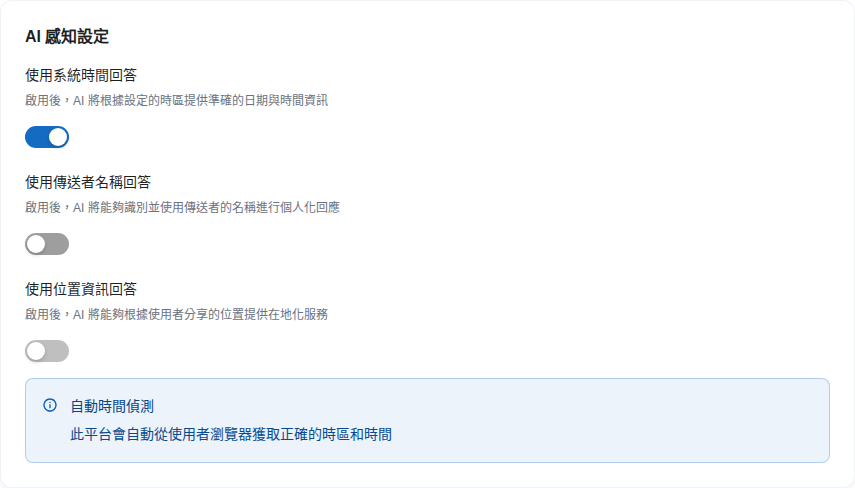
Scroll to <mark style="color:blue;">AI Awareness</mark> and turn on <mark style="color:blue;">Use System Time in Responses</mark>. Web and internal channels display “Automatic time detection” when enabled. The time zone comes from the user's browser, so no manual configuration is needed.

<figure><img src="https://1360999650-files.gitbook.io/~/files/v0/b/gitbook-x-prod.appspot.com/o/spaces%2F6v6TNkkOQVfRYfcNirHL%2Fuploads%2Fgit-blob-e98c22467e67fcfedfdefa0ca159f3038d031e37%2Fplatform-settings-ai-awareness-web.png?alt=media" alt="AI Awareness settings for a web channel, showing ‘Automatic time detection’ after Use System Time in Responses is enabled"><figcaption><p>Web channel: enabling the switch shows “Automatic time detection”; the time zone comes from the user's browser</p></figcaption></figure>

When enabled for API channels and messaging channels such as LINE, a <mark style="color:blue;">Time Zone</mark> dropdown appears, with the <mark style="color:blue;">Current Time</mark> in that time zone displayed below for confirmation. The default is Asia/Taipei (Taipei time, UTC+8). Search to switch to another time zone.

<figure><img src="https://1360999650-files.gitbook.io/~/files/v0/b/gitbook-x-prod.appspot.com/o/spaces%2F6v6TNkkOQVfRYfcNirHL%2Fuploads%2Fgit-blob-124cdad343b0272ab7d84843a4f858c16f4a29d1%2Fplatform-settings-ai-awareness-api.png?alt=media" alt="AI Awareness settings for an API channel, showing a time zone dropdown and current time after Use System Time in Responses is enabled"><figcaption><p>API channel: select the time zone manually; its current time is displayed below</p></figcaption></figure>

#### How the Time Zone Is Determined <a href="#timezone-resolution" id="timezone-resolution"></a>

The injected time is converted to the user's time zone. The source of the time zone varies by channel:

| Platform                                                            | Time zone source                                                                                                                                                                           | Manual configuration required?                                                        |
| ------------------------------------------------------------------- | ------------------------------------------------------------------------------------------------------------------------------------------------------------------------------------------ | ------------------------------------------------------------------------------------- |
| Web, internal                                                       | Automatically uses the user's browser time zone, included with each message                                                                                                                | No; the screen displays "Automatic time detection"                                    |
| API                                                                 | The caller includes `timezone` in the message metadata (in IANA format, such as `America/New_York`); if omitted, the platform's <mark style="color:blue;">Time zone</mark> setting is used | Recommended as the default when no time zone is provided                              |
| Messaging platforms such as LINE, Microsoft Teams, Slack, and Email | Always uses the platform's <mark style="color:blue;">Time zone</mark> setting                                                                                                              | Yes; for platforms primarily serving users overseas, select the appropriate time zone |

{% hint style="info" %}
Messaging platforms cannot obtain the user's local time zone, so when a single LINE platform serves users in multiple countries, the AI can only respond using one fixed time zone. If your users span multiple regions, we recommend creating a separate platform for each region.
{% endhint %}

Example of including a time zone in a message when integrating via API:

```json
{
  "message": {
    "content": "What time is it now?",
    "metadata": { "timezone": "America/New_York" }
  }
}
```

If the time zone string is invalid, the API rejects the request and returns a validation error.

### Respond using the sender's name <a href="#sender-name" id="sender-name"></a>

When enabled, the AI knows the other person's name and addresses them by name when appropriate. The name comes from the contact associated with this conversation—the name shown under <mark style="color:blue;">Customer service conversations</mark> → <mark style="color:blue;">Contacts</mark>. For messaging platforms, it is created automatically from the user's display name on that platform. For web platforms, it comes from the logged-in user or the information entered in the [pre-chat form](https://docs.maiagent.ai/maiagent-user-guide/en/build/choose-channel/web-chat.md#pre-chat-form). If the contact has no name, the AI responds as usual.

### Respond using location information <a href="#gps-location" id="gps-location"></a>

When enabled, the AI uses the user's coordinates to provide localized responses, such as recommending the nearest store. Location sources: the web chat window includes the location with messages after obtaining location permission from the browser; for API platforms, the caller includes `latitude` and `longitude` in the message metadata. This toggle is currently available for web, internal, API, and LINE platforms.

## 8. Frequently Asked Questions <a href="#faq" id="faq"></a>

### Q: Why does the AI still give the wrong date after I enable "Respond using system time"? <a href="#faq-still-wrong" id="faq-still-wrong"></a>

First, confirm that you enabled the setting on the platform the user is actually using (for example, if the issue occurs on LINE, enable the LINE platform's toggle rather than the web platform's). Then check that the messaging platform's <mark style="color:blue;">Time zone</mark> is correct.

### Q: Do I need to add "Today is \[month/day]" to the role instructions? <a href="#faq-prompt" id="faq-prompt"></a>

No, and we do not recommend it. The system automatically provides the time with each request; hardcoding a date in the role instructions can give the AI two conflicting dates.

### Q: Does the AI call an external service to check the time? <a href="#faq-external" id="faq-external"></a>

No. The time comes from the platform server's clock, is converted to the appropriate time zone, and is provided directly to the AI without calling any external API.

### Q: Is daylight saving time handled automatically? <a href="#faq-dst" id="faq-dst"></a>

Yes. Time zones are configured using IANA names (such as `America/New_York`), and the system automatically adjusts for daylight saving time changes.

### Q: Is this time zone the same as the service hours time zone in "Human handoff settings"? <a href="#faq-service-hours" id="faq-service-hours"></a>

These are two independent settings. The time zone here is used for AI responses; the service hours in [Human handoff settings](https://docs.maiagent.ai/maiagent-user-guide/en/build/conversation-settings/human-handoff.md) have their own time zone, which determines when human agents are considered on duty.

### Q: Will the AI still use tools if I hide tool cards in "Tool display mode"? <a href="#faq-tool-hidden" id="faq-tool-hidden"></a>

Yes. "Hidden" only hides the tool execution block in the conversation; it does not disable the tool. Configure the tool display mode in [Response loading style](https://docs.maiagent.ai/maiagent-user-guide/en/build/conversation-settings/platform-settings/loading-display.md#narrative-tool-display). To prevent the AI from calling a particular tool, remove it from the Agent's "Tools" configuration.


---

# Agent Instructions
This documentation is published with GitBook. GitBook is the documentation platform designed so that both humans and AI agents can read, navigate, and reason over technical content effectively. Learn more at gitbook.com.

## Querying This Documentation
If you need additional information that is not directly available in this page, you can query the documentation by asking a question.

Perform an HTTP GET request on the following URL with the `ask` and `goal` query parameters:

```
GET https://docs.maiagent.ai/maiagent-user-guide/en/build/conversation-settings/platform-settings/function-settings.md?ask=<question>&goal=<user_goal>
```

`ask` is the immediate question: it should be specific, self-contained, and written in natural language.
`goal` is what the user is ultimately trying to achieve, the reason they need the answer. Sharing it helps GitBook give you a better, more relevant answer. A goal is most helpful when it describes the outcome the user wants rather than restating the question. For example, with `ask=how do I create an API token`, a goal like `automate deployments from our CI pipeline` lets GitBook tailor the answer to that use case.

The response will contain a direct answer to the question and relevant excerpts and sources from the documentation.

Use this mechanism when the answer is not explicitly present in the current page, you need clarification or additional context, or you want to retrieve related documentation sections.