> For the complete documentation index, see [llms.txt](https://docs.maiagent.ai/llms.txt). Markdown versions of documentation pages are available by appending `.md` to page URLs; this page is available as [Markdown](https://docs.maiagent.ai/maiagent-user-guide/en/build/choose-channel/team-plus.md).
# Connect a Conversation Platform: Team+
Connect the Team+ enterprise messaging platform: enable the API in the Team+ admin console to obtain credentials, create a conversation platform in MaiAgent, and enter the Webhook URL. Only one-on-one
Team+ is an enterprise messaging platform. Once connected, employees can chat with an Agent directly in Team+ without opening another system.
{% hint style="warning" %}
The Team+ integration currently **supports only one-on-one conversations**. Adding an Agent to a group chat will not trigger replies or create conversation records in MaiAgent. If you need group conversations, use another conversation platform.
{% endhint %}
## Before You Connect
* You have created an AI Assistant on the [MaiAgent platform](https://admin.maiagent.ai/)
* You have administrative access to the Team+ service channel (you can access its Feature Settings)
* You have confirmed with your Team+ vendor contact whether your organization uses a test or production environment
{% hint style="warning" %}
**Credentials cannot be changed after the channel is created.** Obtain all three credentials before proceeding to Step 2.
{% endhint %}
***
## Step 1: Enable the API and Obtain Credentials in the Team+ Admin Console
Log in to the Team+ admin console, then go to Service Channels → select the channel you manage → Feature Settings → API Settings, and **enable the API**.
On the same page, obtain these three items after enabling the API:
| Credential | Description |
| ------------------------ | -------------------------------------------------------------------- |
| **Channel ID** | The identifier of this service channel |
| **Channel Secret** | Verifies that messages sent by Team+ actually come from your channel |
| **Channel Access Token** | Used by MaiAgent to call the Team+ API to send replies |
{% hint style="info" %}
Skip the Webhook field for now. It requires the Webhook URL generated by MaiAgent. You will return to fill it in during **Step 3**.
{% endhint %}
***
## Step 2: Create a Team+ Conversation Platform in MaiAgent
### 1. Open Connect Conversation Platform
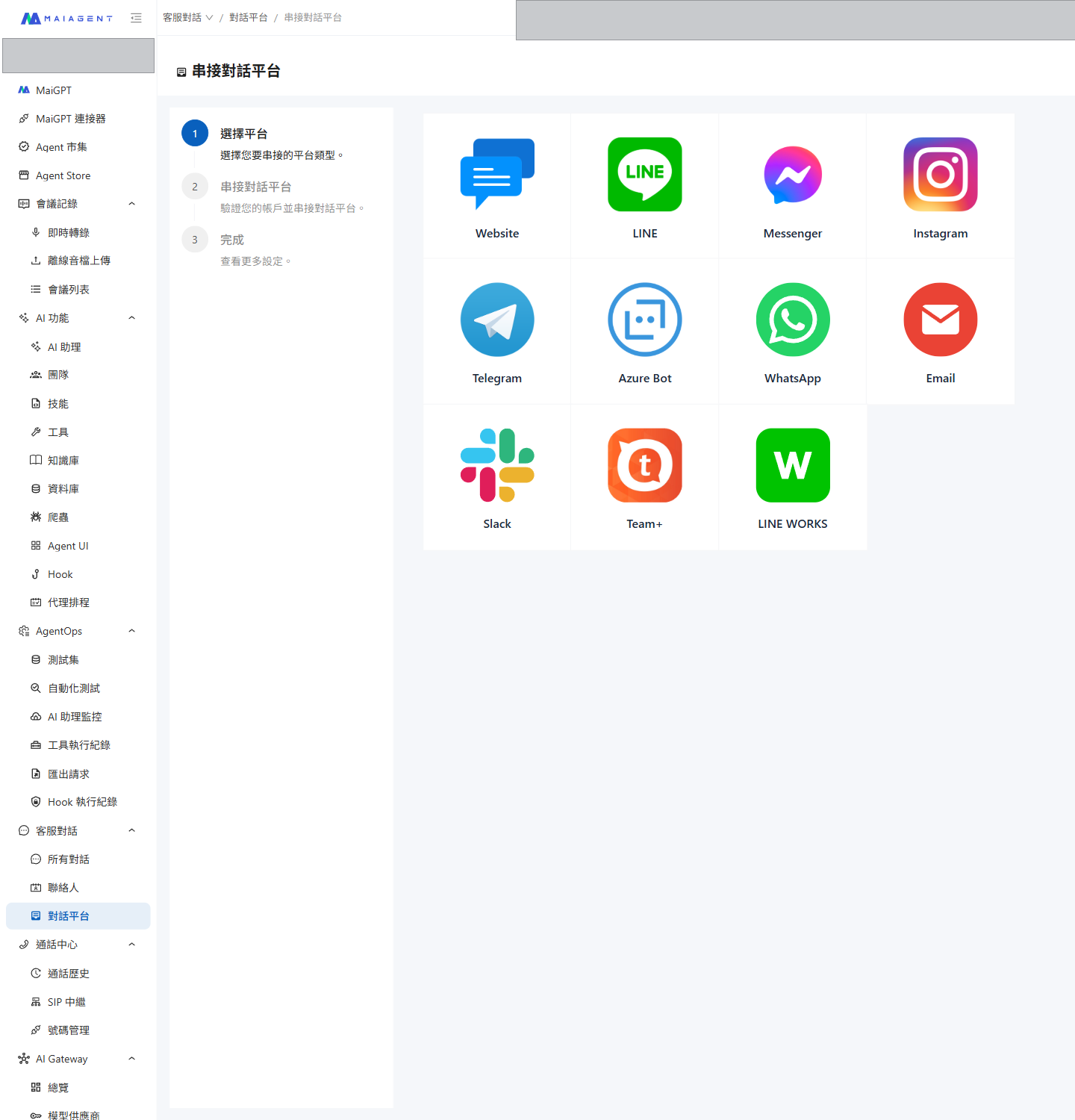
In the MaiAgent left menu, click Conversation Platforms, click Connect Conversation Platform in the upper-right corner, and select Team+.
Select Team+ from the platform list
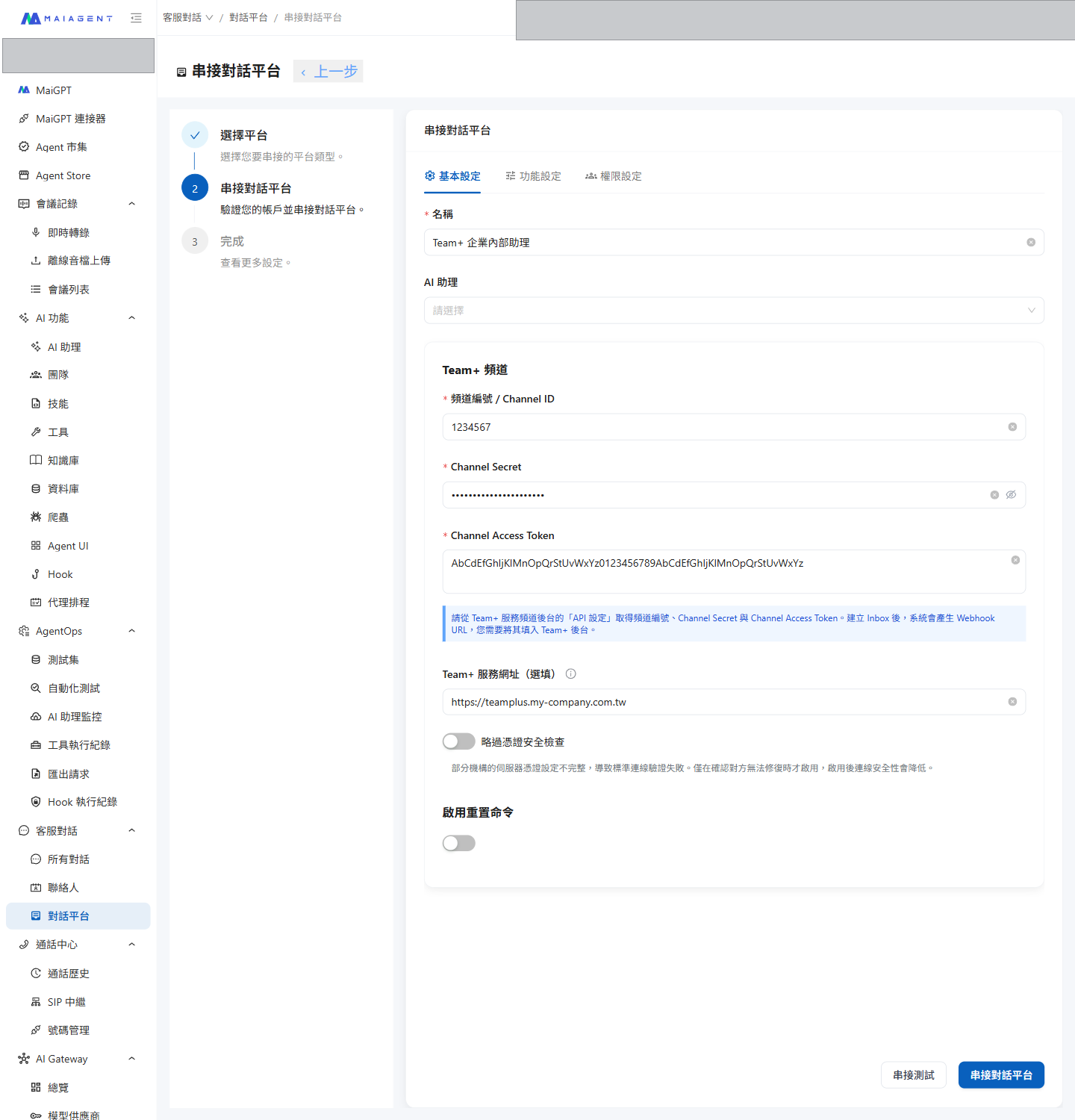
### 2. Fill In the Basic Settings
| Field | Description |
| -------------------------------- | ------------------------------------------------------------------------------ |
| **Name** | Give this integration a name (required). This is only a label within MaiAgent. |
| **AI Assistant** | Select the Agent to connect |
| **Channel ID** | Obtained in Step 1 (required) |
| **Channel Secret** | Obtained in Step 1 (required) |
| **Channel Access Token** | Obtained in Step 1 (required) |
| **Team+ Service URL (optional)** | See the explanation below |
Team+ creation form (example values shown)
### 3. When to Enter a Team+ Service URL
* **Leave blank** — Uses the test environment. Leave it blank for typical testing scenarios.
* **Enter a URL** — Your organization uses a production environment, or Team+ is deployed on your own server. Obtain the URL from your Team+ vendor contact. It must be a complete URL starting with `http://` or `https://`.
### 4. Skip Certificate Security Check
The Skip Certificate Security Check option appears in the form **only after you enter a Team+ Service URL**.
Some organizations have incomplete TLS certificate configurations on their servers (for example, a missing intermediate certificate). This causes standard connection verification to fail, preventing MaiAgent from connecting to Team+. Enabling this option skips verification so the integration can work.
{% hint style="danger" %}
Enabling this option **reduces the security of the connection** to the Team+ server, as MaiAgent cannot confirm that it is connecting to your server. Enable it only after the server administrator has confirmed that the certificate issue cannot be fixed, and disable it once the certificate is repaired.
{% endhint %}
### 5. Enable Reset Commands
Once enabled, you can add one or more command phrases (for example, “Start over”). When a user's message in Team+ exactly matches one of these phrases, a new conversation is started for that user. The command itself receives no reply. The AI responds in the new conversation when the user sends their next message.
### 6. Feature Settings Tab
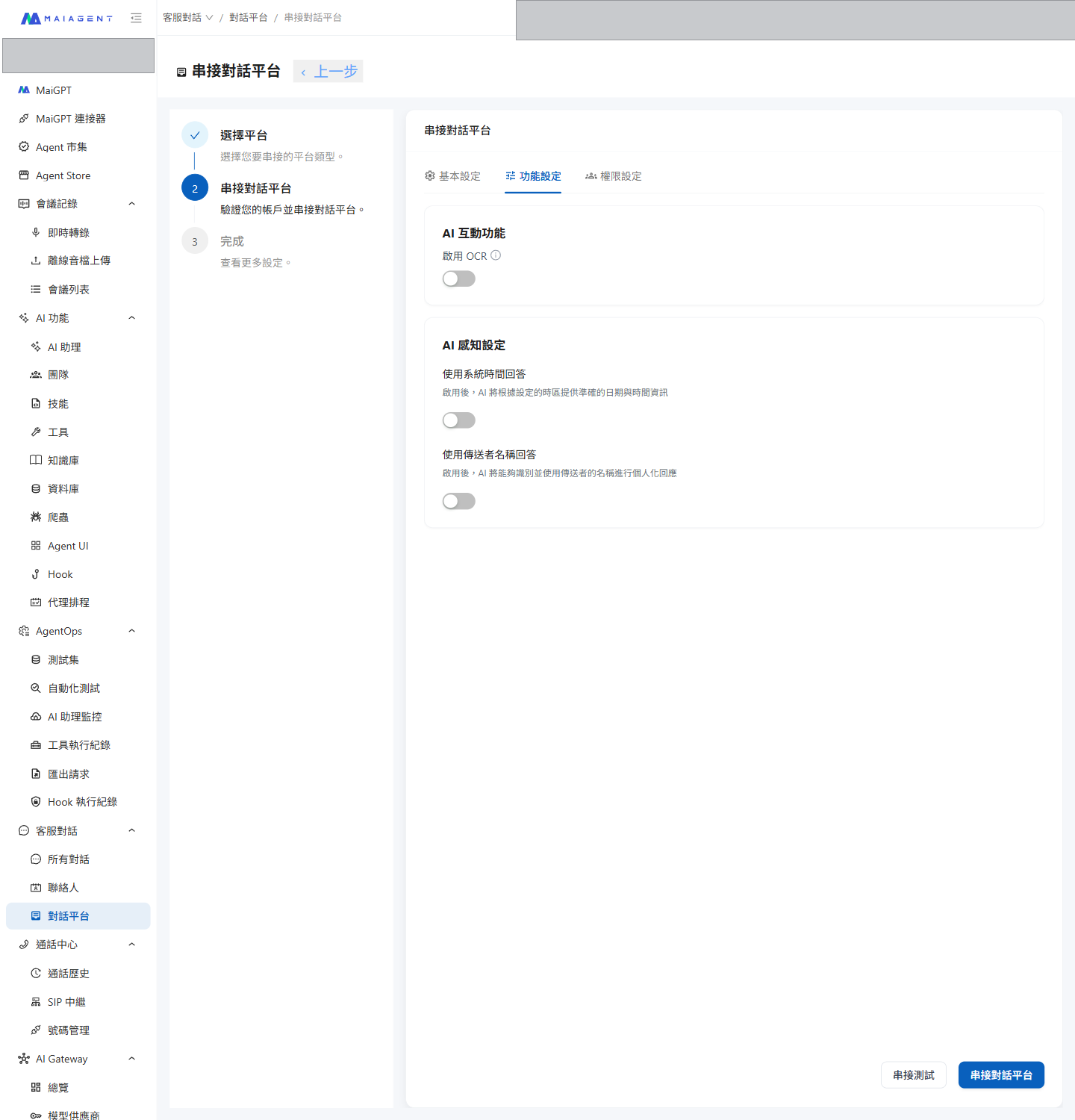
Switch to the Feature Settings tab to adjust the Agent's behavior on this conversation platform:
The toggles on this tab (Enable OCR, Use System Time in Responses, and Use Sender Name in Responses) are shared with other conversation platforms. For explanations of each toggle and the time zone rules, see [Feature Settings](https://docs.maiagent.ai/maiagent-user-guide/en/build/conversation-settings/platform-settings/function-settings.md).
Feature Settings tab
### 7. Test the Integration
Click Test Integration. MaiAgent makes a Team+ API call to verify the credentials.
If Credential verification failed appears, check the following in order:
* The Channel ID and Channel Secret come from the same service channel
* The API is enabled in the Team+ admin console
* If you entered a service URL, it is accessible from outside your network; for certificate issues, see “Skip Certificate Security Check” above
### 8. Create the Platform and Copy the Webhook URL
Click Connect Conversation Platform to finish creating it. The system generates a **Webhook URL**. Copy it for later use.
You can also return to the channel's settings page at any time to copy this URL.
***
## Step 3: Enter the Webhook URL in the Team+ Admin Console
Return to the API Settings page from Step 1, enter the **Webhook URL** generated by MaiAgent in the Webhook field, and save.
Employees can now send messages to this service channel in Team+, and the Agent will reply automatically.
***
## Getting Started
### Supported Message Types
| User Sends | How the Agent Handles It |
| ----------------------------- | ------------------------------------------------- |
| Text | Answers directly |
| Image | Can recognize the image content |
| File (PDF, Excel, Word, etc.) | Reads the content and answers related questions |
| Voice message | Converts to text for processing |
| Video | Saves as an attachment in the conversation record |
| Location | Records it in the conversation |
Agent replies support text and attachments. If a single text message exceeds the Team+ limit of 4,000 characters, the system automatically splits it into multiple messages without truncation.
***
## FAQ
### Why Does the Agent Not Respond in Group Chats?
The Team+ integration currently handles only one-on-one conversations. Group chat messages do not trigger replies or appear in MaiAgent's All Conversations.
This differs from platforms such as LINE WORKS, Slack, and Microsoft Teams, which support groups and can be configured to reply only when @mentioned.
### Why Can't Credentials Be Changed?
Credentials are sensitive data. After storing them, MaiAgent does not return them to the frontend or accept changes on the settings page, to avoid exposing them repeatedly during transmission or on screen. The Channel ID is displayed as read-only so you can verify which service channel is connected.
To replace any credential, delete this channel and create it again.
### The Agent Suddenly Stopped Replying
Check the following in order:
* The API is still enabled in the Team+ admin console
* The URL is still present in the Webhook field (it may be cleared when settings are changed in the admin console)
* The Channel Access Token has not been regenerated in the Team+ admin console—if it has, the old token is invalid, and you must delete this channel and recreate it with the new credentials
* If you use your own server, it is still accessible from outside your network
### Can Test and Production Environments Coexist?
Yes. Create two Team+ conversation platforms, each with its own credentials and service URL. Each has an independent Webhook URL, so they do not affect each other.
---
# Agent Instructions
This documentation is published with GitBook. GitBook is the documentation platform designed so that both humans and AI agents can read, navigate, and reason over technical content effectively. Learn more at gitbook.com.
## Querying This Documentation
If you need additional information that is not directly available in this page, you can query the documentation by asking a question.
Perform an HTTP GET request on the following URL with the `ask` and `goal` query parameters:
```
GET https://docs.maiagent.ai/maiagent-user-guide/en/build/choose-channel/team-plus.md?ask=&goal=
```
`ask` is the immediate question: it should be specific, self-contained, and written in natural language.
`goal` is what the user is ultimately trying to achieve, the reason they need the answer. Sharing it helps GitBook give you a better, more relevant answer. A goal is most helpful when it describes the outcome the user wants rather than restating the question. For example, with `ask=how do I create an API token`, a goal like `automate deployments from our CI pipeline` lets GitBook tailor the answer to that use case.
The response will contain a direct answer to the question and relevant excerpts and sources from the documentation.
Use this mechanism when the answer is not explicitly present in the current page, you need clarification or additional context, or you want to retrieve related documentation sections.